Sustainable interior design in Bangladesh is no longer a niche aspiration — it is becoming a mainstream expectation, driven by globally aware clients, corporate ESG commitments, and the straightforward practical reality that sustainable specifications often perform better and cost less to operate over their lifetime than conventional alternatives. This guide covers the practical dimensions of sustainable interior design in Bangladesh — what it means in the specific context of the country’s climate, supply chain, and construction culture, and how House De Arch integrates sustainability into every project without compromising design quality or budget efficiency.
Why Sustainability Matters Particularly in Bangladesh
Bangladesh is among the countries most vulnerable to climate change — the Bengal Delta, the coastal communities, and the river systems that define the country’s geography are all acutely sensitive to rising sea levels, increased cyclone intensity, and shifting monsoon patterns. For Bangladeshi clients and organisations with a genuine sense of responsibility toward their country’s future, sustainable design is not an abstract global trend but a locally specific moral commitment.
At the same time, the practical case for sustainable specification in Bangladesh is compelling on purely economic grounds. LED lighting reduces energy costs by 70–80% compared to fluorescent alternatives. Natural ventilation strategies reduce air conditioning load in a country where energy costs are significant. Locally sourced materials reduce transportation costs and support local craft industries. Durable, quality materials reduce replacement frequency over the building’s lifetime. Sustainability and cost efficiency are aligned interests in this market.
Locally Sourced Materials
Bangladesh has a rich palette of locally available natural materials that are both sustainable and beautiful — and that give locally designed interiors a distinctly Bangladeshi character that imported materials cannot achieve. Key locally sourced options:
- Bamboo: One of the world’s fastest-growing plants and an exceptionally strong, durable material available throughout Bangladesh. Bamboo flooring, wall panelling, furniture frames, and decorative elements are increasingly available in processed forms suitable for premium interior applications.
- Jute: Bangladesh is the world’s largest jute producer, and jute-based floor coverings, wall textiles, and decorative objects offer a sustainable, locally rooted material choice with genuine aesthetic quality.
- Terracotta and local ceramics: Bangladesh’s ceramic tradition produces handmade tiles, vessels, and decorative objects in natural clay — materials with low embodied energy, zero import cost, and authentic local character.
- Reclaimed timber: Reclaimed timber from old buildings and demolition sites — cleaned, treated, and repurposed — reduces demand for new timber while providing aged character that new wood cannot replicate.
- Natural stone: Bangladesh has domestic stone resources, and regionally sourced stone from India (widely available through established supply chains) represents a significantly lower transportation footprint than European or Chinese stone imports.
Energy Efficiency in Interior Design
LED Lighting Throughout
LED lighting uses 70–80% less energy than fluorescent alternatives and 90% less than incandescent. In Bangladesh, where electricity costs are significant and air conditioning loads are high (inefficient lighting adds heat load to the space, increasing cooling demand), the energy saving from LED throughout a commercial or residential space is substantial. All House De Arch projects specify LED exclusively — it is not a sustainable option; it is simply the correct specification.
Maximising Natural Light
Every lux of natural light that enters a space through a window or skylight is a lux that does not need to be produced by an electrical fitting. Space planning that positions regularly occupied workstations and living areas within 6 metres of a window, glass partition systems that distribute daylight deeper into floor plates, and light-coloured interior finishes that reflect natural light further into spaces all reduce artificial lighting demand.
Natural Ventilation Strategies
Bangladesh’s climate offers genuine natural ventilation opportunities during the cooler months (October–March). Cross-ventilation design — positioning openings on both sides of a space to allow prevailing wind to drive air movement — significantly reduces mechanical ventilation and cooling requirements during these months. Stack ventilation (using the height difference between low-level inlets and high-level exhausts to drive air movement without mechanical assistance) is effective in taller spaces. Passive cooling strategies built into the design reduce the air conditioning load that drives Bangladesh’s high commercial energy costs.
Low-VOC Materials and Indoor Air Quality
Volatile Organic Compounds (VOCs) — emitted by conventional paints, adhesives, sealants, and some furniture materials — degrade indoor air quality and have documented health impacts on regular occupants. In Bangladesh, where buildings are often sealed for air conditioning, indoor VOC concentrations can reach levels that affect occupant health and productivity. Low-VOC or zero-VOC alternatives are available for virtually every interior material category at comparable cost — specifying them is a straightforward design decision with measurable wellbeing benefits.
Biophilic Design as Sustainability
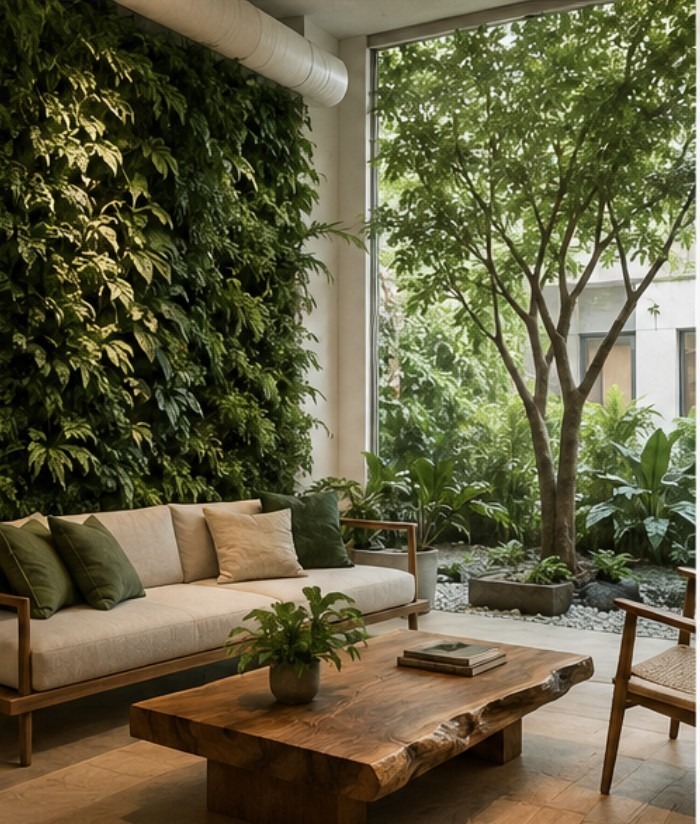
Biophilic design — integrating living plants, natural materials, and natural light into interior environments — is not merely aesthetic in Bangladesh’s context. Living walls and indoor planting improve indoor air quality (plants absorb CO₂ and VOCs), reduce humidity extremes, moderate temperature, and provide the documented psychological wellbeing benefits that reduce absenteeism, improve productivity, and increase satisfaction with the built environment. In Bangladesh’s warm, humid climate, indoor plants thrive with minimal care — the maintenance commitment that deters biophilic design in cooler, drier climates is largely absent here.
Sustainable Design Cost: Is It More Expensive?
The short answer: upfront costs are broadly similar for most sustainable specifications; lifetime costs are significantly lower. LED lighting costs more per fitting than fluorescent alternatives but saves more in energy costs within 18–24 months. Locally sourced natural materials are often less expensive than imported alternatives. Quality, durable materials cost more than budget alternatives but last longer — the total cost of ownership is lower even when the purchase price is higher.
For clients evaluating sustainable design specifications, the calculation should be based on lifetime cost, not purchase price. House De Arch provides lifecycle cost analysis for key specification decisions as part of our design service — allowing clients to make material choices based on their true financial implications.
Related: Interior Design Trends 2025 | PKP Cottage Case Study | Interior Design Styles Guide | EPC Integrated Delivery | Interior Design Cost Guide
Committed to sustainable design for your project? Contact House De Arch — we integrate sustainability into every project as a standard, not an option.