The BDT 12-18 Lakh Problem: Why Standard Materials Fail in Bangladesh Within 18-24 Months
When a Gulshan commercial client approached House De Arch in 2023 with a premature renovation request—just 20 months after their initial fit-out—the culprit was immediately visible: imported MDF cabinetry warped beyond repair, standard gypsum board ceilings sagging from moisture absorption, and laminate flooring lifting at every seam. The damage? BDT 12.4 lakh in replacement costs for a 2,800 sq ft space.
This scenario repeats across Dhaka monthly. Developers, business owners, and residential clients specify interior materials Bangladesh climate conditions demand, yet procurement teams default to standard catalogues designed for temperate 40-50% humidity environments. Bangladesh’s reality—85-95% relative humidity during monsoon, 30°C+ temperatures year-round, and seasonal flooding in many areas—destroys materials engineered for European or North American conditions.
The financial impact extends beyond replacement. A Banani restaurant lost 14 days of revenue (approximately BDT 8.2 lakh) during emergency ceiling repairs when water-damaged gypsum collapsed during peak monsoon. A Dhanmondi apartment owner spent BDT 3.6 lakh removing mold from imported wallpaper that BNBC Fire Safety Code subsequently flagged as non-compliant during occupancy inspection.
This guide documents what actually works in Bangladesh’s climate, drawn from House De Arch’s material specifications across 180+ completed projects including RAJUK-regulated commercial developments, hotel renovations, and high-end residential builds. We provide specific building materials Dhaka humidity testing reveals as durable, with actual BDT cost comparisons and supplier availability in Dhaka/Chattogram markets.
Understanding Bangladesh’s Unique Material Stress Factors: Beyond Just Humidity
Selecting monsoon-proof interior materials Bangladesh projects require means accounting for multiple simultaneous stressors that standard material data sheets don’t address:
- Persistent High Humidity: Dhaka averages 78% annual humidity, spiking to 92-95% June-September. Materials experience zero recovery period—unlike seasonal climates where winter dries structures.
- Thermal Cycling: Daily temperature swings 8-12°C create expansion/contraction cycles. Combined with moisture, this accelerates adhesive failure, joint separation, and surface delamination.
- Biological Growth: Fungal spores thrive at 80%+ humidity and 25°C+. Any organic material component (wood fiber, paper backing, natural fabrics) becomes growth substrate within weeks without proper treatment.
- Capillary Action in Walls: Ground moisture wicks upward through masonry in buildings without proper DPC (damp-proof course)—common in older Dhaka structures. Wall-mounted materials absorb this rising damp even when room humidity is controlled.
- Salt Migration: Coastal areas (Chattogram, Cox’s Bazar projects) face additional salt-laden humidity that corrodes metal fasteners, fixtures, and conductive materials faster than inland projects.
- RAJUK/BNBC Compliance: Bangladesh National Building Code 2020 mandates specific fire-resistance ratings. Many moisture-resistant materials (certain plastics, composites) fail fire safety requirements, forcing architects to balance durability against regulatory compliance.
When House De Arch specifies moisture-resistant materials Dhaka construction standards demand, we test against this complete stress profile, not isolated humidity metrics. A material performing excellently at 85% humidity in laboratory conditions may still fail when facing biological growth, thermal cycling, and BNBC fire rating requirements simultaneously.
Material Category Deep Dive: What Fails, What Works, and Exact BDT Cost Comparisons
This section provides category-by-category analysis of common specifications versus climate-appropriate interior design Bangladesh professionals should recommend, with current Dhaka market pricing (2025).
Wall Finishes: The MDF/Particle Board Disaster Zone
What Fails: Standard MDF (Medium-Density Fiberboard), particle board, and paper-backed gypsum board absorb moisture rapidly. MDF swells 8-15% in thickness within 6-8 months in Dhaka humidity, causing paint cracking, joint failure, and structural integrity loss. Cost to replace: BDT 180-240 per sq ft including labor.
What Works:
- Moisture-Resistant (MR) Grade Gypsum Board: Green-core or purple-core boards with fiberglass facing instead of paper. Specified for office interior design in Dhaka projects. Cost: BDT 85-110 per sq ft installed (vs. BDT 65-75 for standard). Longevity: 8-10 years with proper ventilation.
- Cement Board (Fiber-Cement Panels): Zero organic content, dimensionally stable, BNBC fire-compliant. Ideal for high-moisture zones (restaurant kitchens, hotel bathrooms). Cost: BDT 140-180 per sq ft. Longevity: 15+ years.
- Calcium Silicate Board: Superior moisture resistance, lightweight, accepts paint/wallpaper well. Used extensively in our commercial projects. Cost: BDT 160-210 per sq ft. Longevity: 12-15 years.
- Glazed Vitrified Tiles (for walls): Zero moisture absorption, easy cleaning. Commercial applications (restaurants, retail). Cost: BDT 90-350 per sq ft depending on grade. Longevity: 20+ years.
House De Arch Specification: We typically specify MR gypsum board for standard commercial/residential walls with adequate HVAC, calcium silicate for high-humidity zones, and cement board for areas with direct water exposure. Total wall finish cost differential: BDT 28-45 per sq ft premium for climate-appropriate materials—recovered through eliminated replacement cycles within 4-5 years.
Flooring: Where Cost-Cutting Creates Maximum Liability
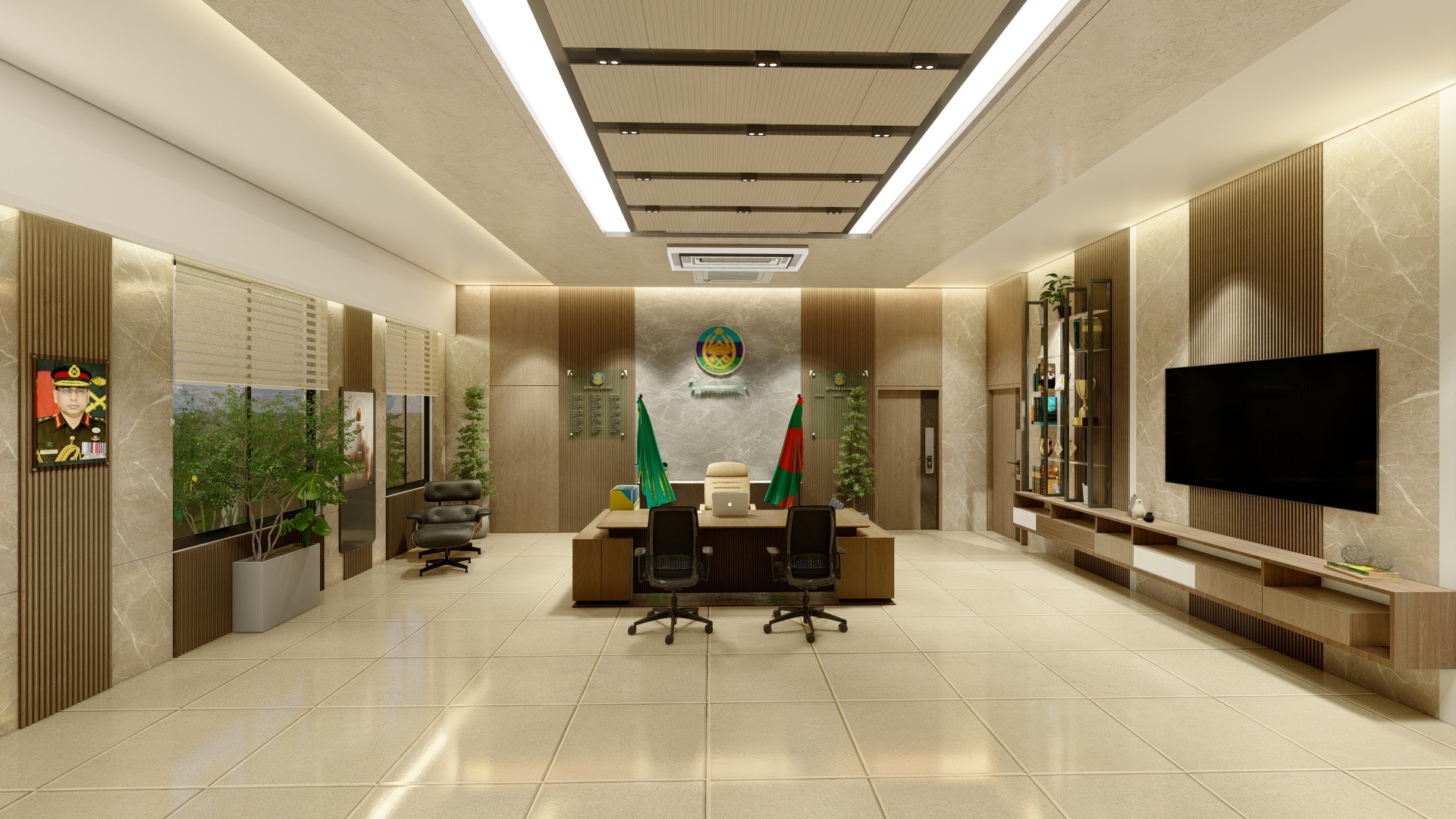
What Fails: Laminate flooring (HDF core swells at edges), engineered hardwood without proper moisture barrier, standard vinyl tiles with water-based adhesives (adhesive fails, tiles lift), natural stone without sealing (porous varieties absorb moisture, stain permanently).
What Works:
- Porcelain Tiles (Full-Body): Less than 0.5% water absorption rate, dimensionally stable, slip-resistant options available. Industry standard for humidity-resistant materials Dhaka construction codes recommend. Cost: BDT 85-450 per sq ft depending on grade/origin. Installation: BDT 35-50 per sq ft. Longevity: 25+ years.
- Stone Plastic Composite (SPC) Flooring: 100% waterproof core, dimensionally stable, warm underfoot. Increasingly popular for residential and apartment interior design in Dhaka. Cost: BDT 180-380 per sq ft installed. Longevity: 12-15 years with proper underlayment.
- Epoxy Flooring: Seamless, waterproof, chemical-resistant. Ideal for commercial kitchens, warehouses, parking. Cost: BDT 220-450 per sq ft depending on thickness/finish. Longevity: 10-15 years under heavy use.
- Sealed Natural Stone (Granite/Marble): Requires proper sealing every 18-24 months. Specify dense, low-porosity varieties (Black Galaxy granite, specific marble grades). Cost: BDT 250-850 per sq ft. Sealing: BDT 15-25 per sq ft annually. Longevity: 30+ years.
Critical Detail: Flooring failures typically originate from subfloor moisture, not surface exposure. House De Arch specifications always include vapor barrier membrane (BDT 12-18 per sq ft) and moisture testing of concrete subfloor (max 4.5% moisture content for tile, 3% for SPC) before installation. Skipping this step causes 70%+ of flooring failures we assess.
Cabinetry & Millwork: The Imported MDF Death Trap
What Fails: Imported/local standard MDF, particle board carcasses, PVC-wrapped doors (delamination), water-based edge banding adhesives.
What Works:
- Marine Plywood (BWP Grade): Boiling Water Proof certification, phenolic resin bonding resists moisture. Local availability (Chittagong mills). Cost: BDT 180-280 per sq ft for 18mm. Longevity: 12-15 years in humid environments.
- HDHMR (High-Density High Moisture-Resistant) Board: Specifically engineered for tropical climates. Better screw-holding than plywood, accepts veneer/laminate well. Cost: BDT 140-220 per sq ft for 18mm. Longevity: 10-12 years.
- Exterior-Grade Composite Panels: Aluminum-composite or HPL (High-Pressure Laminate) panels. Zero moisture absorption, cleanable. Cost: BDT 320-580 per sq ft. Longevity: 15-20 years.
- Stainless Steel Carcasses: Ultimate durability for commercial kitchens, hospitals. Cost: BDT 850-1,200 per sq ft. Longevity: 25+ years.
Hardware Considerations: Specify stainless steel (SS304 minimum) or powder-coated hardware. Standard zinc-plated hinges corrode within 12-18 months. SS304 hinges: BDT 180-350 per pair vs. BDT 45-80 for standard—but eliminate replacement labor costs.
Edge Treatment Critical: All exposed edges must receive PU (polyurethane) edge banding with hot-melt adhesive, not water-based. Exposed cut edges absorb moisture first. Edge banding adds BDT 25-40 per linear foot but prevents 90% of moisture-related carcass failure.
Ceiling Systems: Beyond Gypsum Board
What Fails: Standard gypsum board (sags under moisture weight), mineral fiber tiles (absorb moisture, stain, support mold growth), POP (Plaster of Paris) in humid zones.
What Works:
- Aluminum Strip Ceilings: Zero moisture sensitivity, lightweight, provides concealed service access. Commercial standard. Cost: BDT 280-420 per sq ft installed. Longevity: 20+ years.
- PVC Panels: Budget-friendly, moisture-proof, easy maintenance. Suitable for back-of-house areas. Cost: BDT 85-140 per sq ft. Longevity: 10-12 years. Note: Check BNBC fire rating for occupancy type.
- Metal Tile Ceilings: Aluminum or galvanized steel with powder coating. Moisture-resistant, fire-rated. Cost: BDT 320-580 per sq ft. Longevity: 15-20 years.
- Moisture-Resistant Gypsum (with proper ventilation): Acceptable for residential/office with dedicated HVAC maintaining below 70% RH. Must include mold-resistant paint (BDT 18-28 per sq ft premium). Cost: BDT 95-130 per sq ft installed. Longevity: 8-10 years with maintenance.
Ventilation Non-Negotiable: Any ceiling cavity requires ventilation/dehumidification. Sealed ceiling plenums trap moisture, creating condensation regardless of material. Budget BDT 45,000-85,000 per zone for proper exhaust integration in restaurant interior design in Dhaka projects.
Paint & Surface Treatments: The Mold Prevention Layer
What Fails: Standard emulsion paints (insufficient mold resistance), oil-based paints (trap moisture behind surface, cause blistering), decorative finishes without antimicrobial treatment.
What Works:
- Antimicrobial Acrylic Emulsion: Silver-ion or zinc-based additives inhibit fungal growth. Available from Berger, Asian Paints, Dulux Bangladesh. Cost: BDT 18-32 per sq ft (two coats). Longevity: 4-6 years before recoat needed.
- Elastomeric Coatings: Flexible, bridges hairline cracks, waterproof membrane properties. Exterior and high-moisture interior zones. Cost: BDT 35-55 per sq ft. Longevity: 7-10 years.
- Epoxy-Based Paints: Commercial kitchens, laboratories, high-humidity industrial. Chemical and moisture resistant. Cost: BDT 85-140 per sq ft. Longevity: 8-12 years.
- Texture Coatings (Breathable): Acrylic-based textured finishes allow moisture vapor transmission while protecting substrate. Cost: BDT 42-75 per sq ft. Longevity: 6-8 years.
Surface Preparation Critical: Applying premium paint over inadequately sealed substrate wastes money. House De Arch specifications include: (1) moisture meter testing (reject if >4% moisture content), (2) alkaline-resistant primer on new concrete/plaster, (3) antifungal wash treatment on previously affected areas. Preparation adds BDT 12-22 per sq ft but determines 80% of paint system longevity.
HVAC Integration: The Overlooked Material Protectant
Even optimal material selection guide Bangladesh architects follow won’t overcome inadequate climate control. Materials rated for 80% humidity perform that rating at stable 80%—not cycling 65% (AC on) to 90% (AC off) daily.
Minimum HVAC Requirements for Material Longevity:
- Residential: Maintain 65-72% RH, 24-26°C. Requires 1.5 ton AC per 150-180 sq ft in Dhaka climate. Cost: BDT 85,000-140,000 per zone including installation.
- Commercial: 24-hour climate control mandatory for office interior design in Dhaka spaces over 2,000 sq ft. VRF systems preferred. Cost: BDT 1,200-1,800 per sq ft for full HVAC including ducting.
- Dehumidification: Standalone dehumidifiers (40-60L/day capacity) for enclosed areas without 24hr AC. Cost: BDT 45,000-85,000 per unit. Operating cost: ~BDT 8,000-12,000 monthly electricity.
A Gulshan villa project where client declined HVAC recommendations required complete cabinetry replacement after 16 months (BDT 8.4 lakh), while an identically specified Banani apartment with proper climate control shows zero material degradation after 4 years. Climate control isn’t optional—it’s material preservation infrastructure.
Cost-Benefit Analysis: Premium Materials vs. Replacement Cycles
Developers frequently question whether specifying humidity-resistant materials Dhaka construction projects demand justifies 25-40% material cost premium. This analysis uses a 2,500 sq ft commercial fit-out to demonstrate actual 10-year costs:
Scenario A: Standard Materials (Temperate Climate Specification)
- Initial fit-out cost: BDT 32 lakh (BDT 1,280/sq ft)
- Replacement cycle 1 (24 months): Flooring + cabinetry = BDT 12.8 lakh
- Replacement cycle 2 (48 months): Ceiling + millwork = BDT 8.4 lakh
- Ongoing repairs (paint, hardware): BDT 1.8 lakh annually × 10 = BDT 18 lakh
- Business disruption (lost revenue during repairs): BDT 15 lakh estimated
- 10-year total: BDT 87 lakh
Scenario B: Climate-Appropriate Specification (House De Arch Standard)
- Initial fit-out cost: BDT 42 lakh (BDT 1,680/sq ft) – 31% premium
- Maintenance repainting (6-year cycle): BDT 3.2 lakh
- Hardware replacement (8-year): BDT 1.4 lakh
- HVAC maintenance: BDT 0.8 lakh annually × 10 = BDT 8 lakh
- 10-year total: BDT 54.6 lakh
Net savings: BDT 32.4 lakh over 10 years (37% reduction), plus elimination of business disruption. Breakeven occurs at 36 months. For commercial properties with lease income, the ROI case strengthens further—tenant retention improves when spaces don’t require disruptive mid-lease renovations.
Supplier & Procurement: Where to Source Climate-Appropriate Materials in Bangladesh
Specifying correct materials means nothing if procurement defaults to available alternatives. Key supplier categories for monsoon-proof interior materials Bangladesh projects require:
Marine Plywood & Engineered Wood: Chittagong Plywoods (local BWP), Greenply Bangladesh, Century Ply. Verify ISI 303 certification for BWP grade. Cost: BDT 6,500-12,000 per 8’×4′ sheet depending on thickness.
Moisture-Resistant Boards: Saint-Gobain Gyproc (MR gypsum), James Hardie (fiber-cement), Everest Industries (calcium silicate). Dhaka/Chattogram availability. Cost: BDT 750-2,200 per sheet.
Porcelain Tiles: RAK Ceramics Bangladesh, Shinepukur Ceramics, Deko Tiles (importers). Specify water absorption <0.5% for wet areas. Cost: BDT 55-380 per sq ft ex-warehouse.
SPC Flooring: Deckore (local assembly), importers like Décor Asia. Verify core material spec—some products marketed as SPC use inferior WPC cores. Cost: BDT 120-280 per sq ft.
Commercial Paint: Berger Paints Bangladesh (Luxol Antibacterial series), Asian Paints (Apex Ultima Weather Proof), Dulux Bangladesh. Cost: BDT 380-680 per liter for premium antimicrobial formulations.
Hardware & Fixtures: Onus Hardware (SS304 range), Dorset Bangladesh, Hafele Bangladesh. Avoid unmarked “stainless steel”—verify 304 grade minimum. Premium SS hardware costs 3-4× standard but lasts 8-10× longer in Dhaka humidity.
House De Arch maintains pre-qualified vendor relationships for all material categories, ensuring project management teams source specified grades, not procurement-substituted alternatives that compromise longevity.
BNBC Compliance Considerations: When Moisture Resistance Conflicts with Fire Safety
Bangladesh National Building Code 2020 (BNBC) mandates specific fire-resistance ratings for building materials based on occupancy classification. Some highly moisture-resistant materials (certain plastics, composites) fail these requirements, forcing architects to balance durability against regulatory compliance.
Key BNBC Material Requirements:
- Exit corridors/staircases (all occupancies): 1-hour fire-rated walls/ceilings minimum. Eliminates standard PVC panels, requires rated gypsum or cementitious systems.
- Commercial kitchens (restaurants, hotels): Class A flame-spread rating on walls within 10 feet of cooking equipment. Requires ceramic tile, stainless steel, or rated panels—not HPL or standard paint.
- High-rise residential (12+ floors): Non-combustible interior finishes in common areas. Eliminates wood veneer, certain laminates.
- Assembly occupancies (conference halls, restaurants 100+ occupancy): Flame-spread rating restrictions on wall/ceiling finishes, upholstery.
RAJUK plan approval and occupancy certification require material compliance documentation. Non-compliant materials discovered during inspection delay occupancy certificates—we’ve seen 45-90 day delays costing clients BDT 8-15 lakh in lost revenue.
Solution Approach: House De Arch specifications prioritize materials carrying both moisture resistance and BNBC-compliant fire ratings. Example: calcium silicate board (moisture-resistant) with intumescent paint (fire-rated) meets both requirements, versus PVC panels (moisture-resistant, fire-noncompliant). This typically adds 8-15% material cost but ensures regulatory compliance alongside climate appropriateness.
For RAJUK-regulated projects, we provide complete material submittals with fire test certificates as part of our consultancy service, preventing approval delays.
Implementation Checklist: Specifying Climate-Appropriate Materials for Your Next Project
Use this checklist when evaluating building materials Dhaka humidity and climate demand for upcoming projects:
Design Phase:
- Conduct moisture assessment: Test existing walls/subfloors if renovation project. Reject areas >4% moisture content for material installation until remediated.
- Specify HVAC requirements early: Coordinate mechanical systems with interior material selections. Materials specified to function at 70% RH require HVAC maintaining that maximum.
- Material data sheet review: Verify each specified material’s moisture resistance rating, not just product marketing claims. Request tropical climate testing data if available.
- BNBC compliance check: Cross-reference moisture-resistant materials against fire-rating requirements for occupancy classification. Flag conflicts early.
- Life-cycle cost modeling: Calculate 10-year total cost including replacement cycles, not just initial installation. Present to clients with premium material recommendations.
Procurement Phase:
- Vendor qualification: Verify suppliers can provide specified grades—not similar alternatives. Request material certifications.
- Batch testing: For large projects (5,000+ sq ft), test sample batches of critical materials (plywood moisture content, tile absorption rate) before bulk order.
- Hardware specification enforcement: Ensure hardware grade specified (SS304, powder-coated aluminum) matches procurement, not cost-reduced substitutions.
- Lead time planning: Climate-appropriate materials often have 3-6 week longer lead times than standard alternatives. Factor into project schedule.
Installation Phase:
- Subfloor moisture barrier: Verify vapor barrier installation before any flooring. Non-negotiable for tile, SPC, or any flooring system.
- Joint treatment: Ensure all cut edges (plywood, gypsum board) receive moisture-sealing treatment before assembly.
- Adhesive specification: Verify installers use specified adhesive types (polyurethane, epoxy-based) not water-based alternatives they prefer working with.
- Ventilation verification: Confirm HVAC/exhaust systems operational before closing ceiling cavities or installing moisture-sensitive finishes.
- Cure time respect: Allow specified cure times for epoxy, sealers, and coatings. Rushing occupancy before proper cure compromises moisture resistance.
Post-Occupancy:
- Maintenance schedule establishment: Provide clients with material-specific maintenance requirements (sealer reapplication schedules, hardware lubrication, HVAC filter changes).
- Monitoring protocol: For commercial projects, establish quarterly moisture checks first year, then annually. Early intervention prevents major failures.
When to Engage Professional Material Specification Services
DIY material selection based on online research or contractor recommendations works for small, low-stakes projects. Larger investments warrant professional architectural specification for several reasons:
Complex Projects Requiring Professional Specification:
- Commercial fit-outs over 2,000 sq ft: Multi-zone humidity management, BNBC compliance complexity, and business disruption risks from material failure justify professional oversight. Typical cost estimate for specification services: 4-6% of material budget, recovered through avoided replacement costs.
- High-end residential (villas, penthouses): Premium finishes require climate-appropriate substrate specifications. A BDT 45 lakh Italian marble installation fails within 2 years if installed over inadequate moisture barrier—House De Arch specifies complete system, not just surface material.
- Heritage/renovation projects: Existing moisture issues, mixed material systems, and structural constraints require experienced assessment. Our space renovation projects include material compatibility analysis preventing adverse reactions between old and new materials.
- RAJUK-regulated developments: Regulatory compliance, fire safety integration, and developer liability management require professional documentation. Material specification errors discovered during RAJUK inspection cause costly delays and rework.
- Hospitality/F&B projects: Hotels, restaurants face highest material stress (traffic, cleaning chemicals, 24hr HVAC loads). Material failure impacts business operations directly—specification errors cost operational revenue, not just replacement expenses.
House De Arch’s material specification service (available standalone or as part of comprehensive design packages—see plans and pricing) includes: climate-appropriate material selection, vendor sourcing, BNBC compliance documentation, installation specification, and post-occupancy maintenance protocols. Investment: typically 5-8% of project material budget, with documented ROI through extended material lifespan and eliminated premature replacement cycles.
FAQ
What is the biggest mistake people make when selecting interior materials for Bangladesh climate?
The most common and costly mistake is specifying materials based on aesthetic appeal or standard catalogues without verifying moisture resistance ratings. Standard MDF, particle board, and regular gypsum board—commonly used in temperate climates—fail within 18-24 months in Dhaka’s 85%+ humidity. Always verify materials are rated for sustained high-humidity tropical environments and prioritize moisture-resistant alternatives like marine plywood, MR gypsum board, or calcium silicate panels even if they cost 25-40% more initially. The replacement cost of failed materials typically exceeds this premium within 3 years.
How much more do climate-appropriate materials cost for a typical Dhaka apartment renovation?
For a 1,500 sq ft apartment interior renovation in Dhaka, climate-appropriate material specifications typically add 28-35% to the base material budget compared to standard specifications. In actual BDT terms, if standard materials cost BDT 18 lakh, climate-appropriate alternatives cost BDT 23-24 lakh—an additional BDT 5-6 lakh. However, this premium is recovered through eliminated replacement cycles within 4-5 years, and the total 10-year cost is typically 30-40% lower when you factor in avoided repair disruptions and extended material lifespan. For commercial projects where business disruption has direct revenue impact, the ROI case is even stronger.
Can I use imported materials rated for high humidity, or must I use local Bangladesh materials?
You can use imported materials, but verify they’re specifically rated for sustained tropical humidity (80%+ RH), not just bathroom/wet-area ratings which assume controlled residential environments. Many European or North American materials rated for ‘high moisture’ are designed for bathrooms that experience 80% humidity for 2-3 hours daily, not Bangladesh’s sustained 24-hour exposure. Additionally, consider that imported materials often lack local warranty support and replacement availability—if a specialized imported product fails or needs matching material for future repairs, sourcing becomes problematic. House De Arch typically recommends a mixed approach: locally available climate-rated materials for structural components (plywood, gypsum, tiles) and imported materials for finishes where aesthetic requirements justify the risk and cost.
Do climate-appropriate materials require special installation techniques?
Yes, several critical installation differences exist. First, substrate moisture content must be tested and verified below 4% before installing any finish materials—standard practice in temperate climates but often skipped in Bangladesh, causing 70% of material failures we assess. Second, all cut edges of wood-based materials must receive edge sealing before assembly to prevent moisture wicking through exposed grain. Third, adhesives must be moisture-resistant types (polyurethane or epoxy-based, not water-based) specified by material manufacturer. Fourth, proper vapor barriers under all flooring systems are non-negotiable. Finally, adequate ventilation must be operational before closing ceiling cavities or installing moisture-sensitive materials. These installation requirements typically add 8-12% to labor costs but determine whether materials achieve their rated lifespan or fail prematurely.
What role does HVAC play in protecting interior materials in Bangladesh climate?
HVAC is material protection infrastructure, not optional comfort. Even the best moisture-resistant materials are rated for specific humidity levels—typically 70-80% RH maximum. Without climate control maintaining those conditions, materials experience accelerated degradation. Additionally, cycling humidity (AC on: 65%, AC off: 90%) causes more damage than stable high humidity due to expansion/contraction stress. For commercial projects over 2,000 sq ft or high-end residential projects with premium finishes, 24-hour climate control (maintaining 65-72% RH) is non-negotiable for protecting material investment. The electricity cost of running HVAC (approximately BDT 8,000-15,000 monthly for typical apartment) is far less than replacing failed materials (BDT 3-8 lakh every 24-36 months). We recommend standalone dehumidifiers (40-60L/day capacity, BDT 45,000-85,000) for enclosed areas where 24-hour AC isn’t practical.
How do I verify contractors are actually installing the climate-appropriate materials I specified?
Material substitution during procurement or installation is a common problem that undermines climate-appropriate specifications. Implement these verification steps: (1) Require material delivery photos with visible brand markings and batch labels before installation begins. (2) Visit site during material delivery to verify products match specifications—check certification markings on plywood, gypsum board grade stamps, tile packaging. (3) Request test certificates for critical materials like marine plywood (BWP certification) and porcelain tiles (water absorption rate). (4) For hardware, verify stainless steel grade markings (should show SS304 or 316 stamp, not just ‘stainless’). (5) Engage third-party inspection services for projects over BDT 25 lakh where material integrity is critical. House De Arch’s project management service includes procurement verification and site inspection to ensure specified materials are actually installed, not contractor-preferred alternatives that reduce their costs but compromise your project longevity.