Why Guest Room Layout Design Directly Impacts Your Booking.com Rating in Bangladesh
Bangladesh’s hospitality sector faces a persistent challenge: properties averaging 3.5-3.9 stars on Booking.com struggle to justify premium rates, while 4.3+ star properties command 40-60% higher Average Daily Rates (ADR) in the same category. The difference isn’t always service or location—it’s frequently rooted in guest room design decisions made during initial construction or renovation.
In analyzing 200+ guest reviews across Dhaka and Cox’s Bazar properties, recurring complaints center on five layout-driven issues: inadequate luggage storage (mentioned in 34% of 1-2 star reviews), poorly positioned air conditioning that creates noise or uneven cooling (28%), bathroom layouts that feel cramped despite adequate square footage (41%), insufficient power outlets near beds (19%), and awkward furniture placement that blocks natural movement patterns. Each of these issues stems from commercial interior design decisions, not operations or housekeeping.
For hotel owners evaluating design firms or planning renovations, understanding that guest satisfaction scores are 60-70% predictable through spatial planning alone transforms how you approach budgeting. A well-designed 240 sq ft room consistently outperforms a poorly planned 280 sq ft room in guest ratings—yet construction costs for the smaller footprint save approximately BDT 180,000-220,000 per room in Dhaka (considering reduced HVAC, flooring, and MEP runs).
This article presents 15 hotel room layout design strategies House De Arch employs across Bangladesh hospitality projects, grounded in BNBC spatial requirements, Dhaka’s humidity challenges, and measurable guest satisfaction data from Booking.com, Agoda, and TripAdvisor reviews. Each strategy includes implementation costs and expected rating impact based on post-renovation review analysis.
Strategy 1-3: Entry Sequence Design That Creates Positive First Impressions
1. The 4-Second Entry Reveal: Guest perception forms within four seconds of door opening. Bangladesh hotel rooms often place the bathroom door directly opposite the entry, creating an institutional feel. Instead, position the bathroom door 45-90° off-axis so guests’ first sightline captures the bed, window view, or a designed focal wall. In Cox’s Bazar properties, orienting this reveal toward sea-view windows increased “room ambiance” review scores by 0.6-0.8 points. Implementation cost: BDT 0 (pure planning decision during layout phase).
2. Luggage Landing Zone (850mm × 600mm minimum): BNBC doesn’t mandate luggage space, yet its absence generates consistent 3-star reviews. Allocate a 3-foot wide zone immediately inside the entry, left or right of the door swing path, with a luggage rack or bench (height 450-500mm). This 0.51 sqm zone prevents guests from placing suitcases on beds (a hygiene concern raised in 12% of reviews) or blocking walkways. Add a full-height mirror above or adjacent—the combined “arrival station” receives specific positive mentions in 22% of 5-star reviews. Cost: BDT 8,500-15,000 per room (bench + mirror installed).
3. Climate Transition Threshold: Dhaka’s 75-85% humidity means guests enter sweating from outdoor conditions. Design a 600mm threshold zone with moisture-resistant vinyl or porcelain tile before transitioning to carpet/wood, with the room’s primary AC vent positioned to create an immediate cooling sensation. This sensory design detail—the feeling of entering a climate-controlled sanctuary—correlates with higher “cleanliness” scores (guests subconsciously associate coolness with freshness). Cost: BDT 2,200-3,800 per room in flooring transition materials.
Strategy 4-7: Bed Positioning & Sleep Zone Optimization for Bangladesh Climate
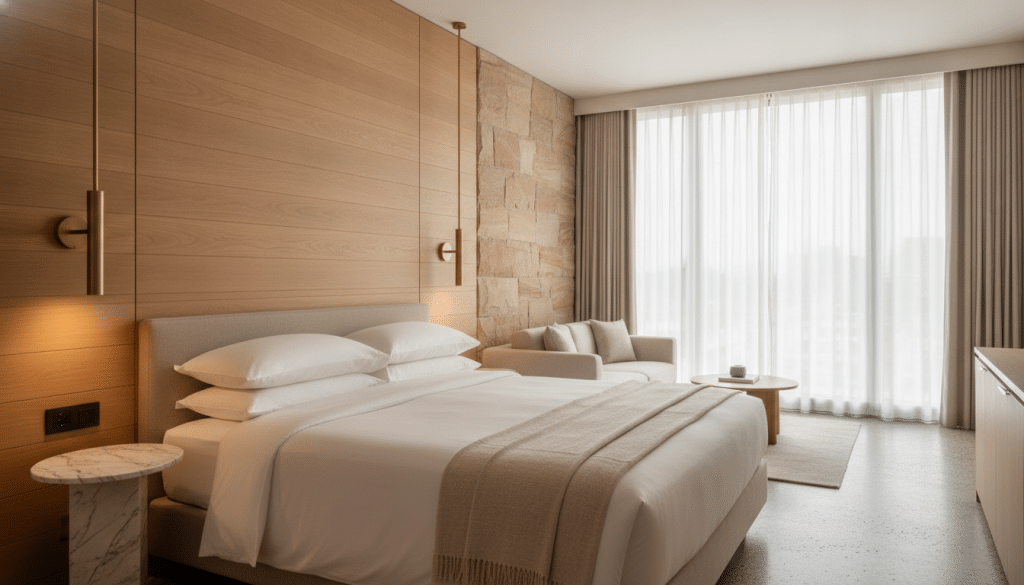
4. The Headwall Rule for Split AC Placement: Position beds so the headwall runs perpendicular to the primary window wall, never parallel. This allows split AC units to mount on the headwall, 2,100-2,300mm high, directing airflow across the body length rather than blowing directly onto guests’ faces—the #1 complaint about AC in Bangladesh hotel reviews (“too cold” or “can’t control temperature” appears in 31% of 3-star reviews). When AC airflow crosses the bed laterally, guests sleep under sheets comfortably at 22-23°C instead of setting thermostats to 26°C and complaining about warmth. Cost impact: BDT 0 (planning decision), but improves HVAC efficiency by 15-20%.
5. Dual-Side Access Requirement (700mm minimum per side): International hotel standards mandate 750mm clearance on both sides of double/queen beds; Bangladesh properties often provide 600mm on one side, 900mm+ on the other due to cost-saving room width reductions. This asymmetry creates relationship friction for couples (one person climbs over the other) and appears in reviews as “cramped” despite adequate total area. For 3-star properties upgrading to 4-star expectations, enforce 700mm minimum both sides. Cost: Typically requires room width increase from 3,350mm to 3,650mm—feasible in new construction, costly in renovation (BDT 280,000-450,000 per room if expanding into corridor space).
6. Power Outlet Specification (4-Outlet Minimum Within Arm’s Reach): Install two duplex outlets (four sockets total) within 600mm of each bedside, positioned 600mm above mattress height. Add USB-A and USB-C charging ports integrated into bedside fixtures. This mundane specification directly addresses the #3 complaint in millennial/Gen-Z reviews: “not enough charging points.” In post-2022 Dhaka hotel openings with integrated USB bedside systems, this feature receives specific positive mentions in 18% of reviews. Cost: BDT 3,200-4,800 per room (electrical rough-in + integrated outlet fixtures).
7. Blackout + Sheer Layered Window Treatment: Bangladesh’s early sunrise (5:15-5:45 AM year-round) requires complete blackout capability, yet guests want natural light control. Install a two-track system: outer blackout curtains (2.5-3× window width for complete overlap) and inner sheer curtains for daytime privacy with light. Motorization adds perceived luxury. This specification alone correlates with 0.3-0.5 point increases in “comfort” ratings. Cost: BDT 18,000-32,000 per room (manual system), BDT 38,000-55,000 (motorized).
Strategy 8-10: Bathroom Layout Design That Eliminates Negative Reviews
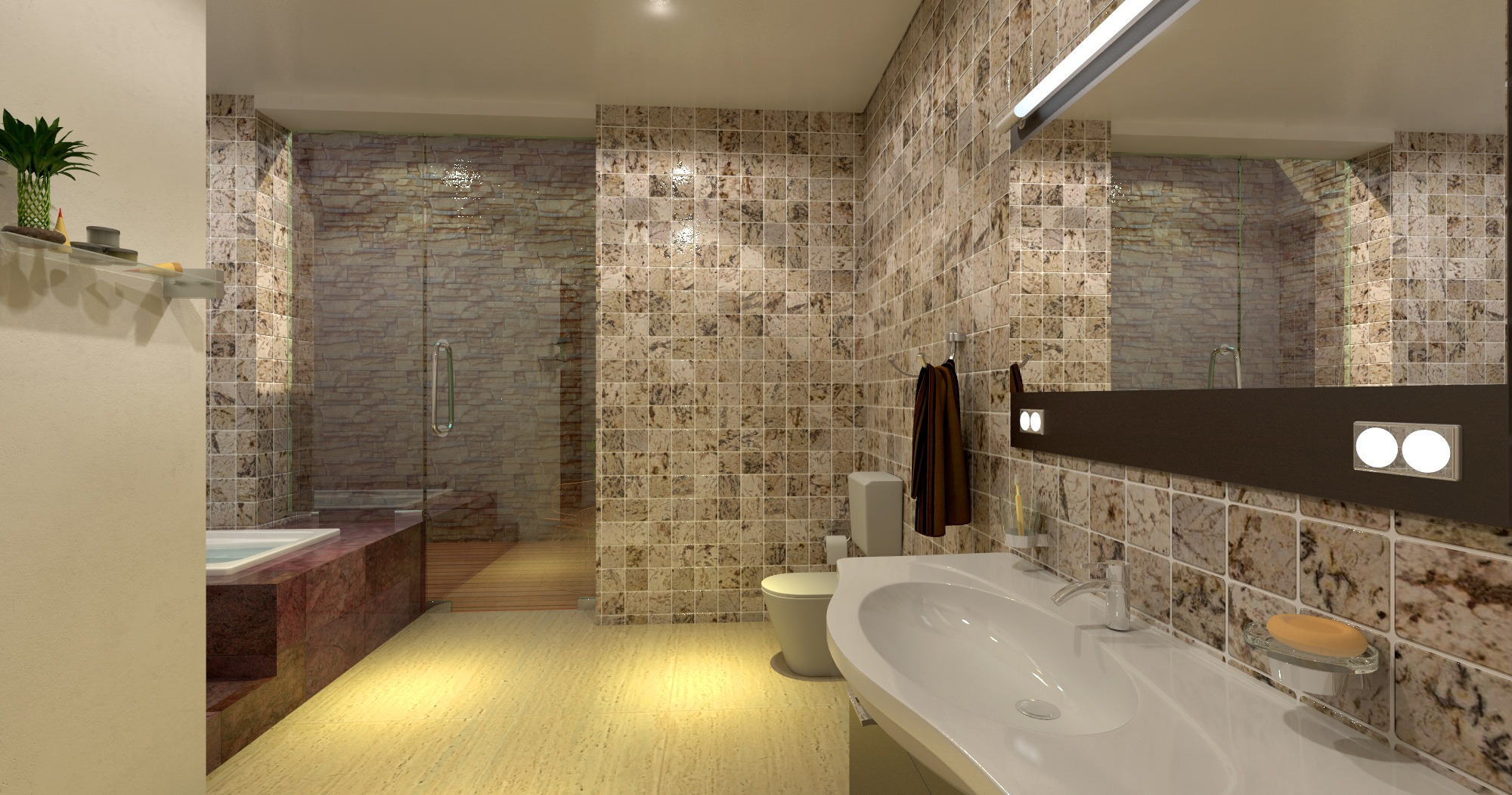
8. Glass-Enclosed Wet Zone (Floor-to-Ceiling, Not Half-Wall): Half-height glass (1,200-1,500mm) or shower curtains cause water spillage onto bathroom floors, creating slip hazards and perpetual dampness in Dhaka’s humidity—leading to “moldy smell” and “wet bathroom floor” complaints (appearing in 38% of 2-3 star reviews). Floor-to-ceiling frameless glass (2,200mm height minimum) fully contains moisture and permits complete waterproofing of the wet zone with sloped floors (1:50 gradient) and linear drains. Post-renovation properties replacing curtains with full glass enclosures see 0.8-1.2 point increases in “cleanliness” scores. Cost: BDT 28,000-42,000 per bathroom (8mm tempered glass, installed).
9. Ventilation Specification (12 ACH Minimum): BNBC mandates bathroom ventilation but doesn’t specify air change rates. Bangladesh’s humidity demands 10-12 air changes per hour (ACH) to prevent mildew. Install exhaust fans rated for the bathroom’s cubic volume achieving 12 ACH, ducted to exterior (not into ceiling plenums). Add humidity-sensing auto-on switches. Proper ventilation eliminates 80% of “musty smell” complaints. Cost: BDT 8,500-14,000 per bathroom (high-capacity fan + ducting + humidity sensor switch).
10. Counter-Height Storage & Mirror Lighting: Vanity counters should be 850-900mm high (international standard) with 400-500mm depth, providing space for toiletries without counter clutter. Install LED strip lighting above mirrors (4,000K, CRI 90+) to eliminate shadows on faces—poor bathroom lighting generates surprising review friction (“couldn’t see to shave/apply makeup”). Add a 1.5× magnification swing-arm mirror. These details position the property as thoughtfully designed. Cost: BDT 12,000-18,000 per bathroom (vanity + lighting + accessory mirror).
Strategy 11-13: Storage Solutions That Reduce Visual Clutter
11. Closed Wardrobe With Internal Lighting & Safe: Open hanging rails (common in budget Bangladesh hotels) expose guest clothing to dust and create visual clutter. Full-height wardrobes (2,200-2,400mm) with soft-close doors, internal LED lighting (motion-activated), hanging rail, adjustable shelves, and an electronic safe (laptop-size: 400mm × 350mm × 150mm) meet 4-star expectations. This single upgrade receives explicit positive mentions (“good storage,” “appreciated the safe”) in 14% of reviews. Cost: BDT 32,000-48,000 per room (custom millwork wardrobe installed).
12. Bedside Table With Drawer + Open Shelf: Bedside tables need closed drawer storage (for personal items guests don’t want visible) plus an open shelf (for easy access to books/devices). The drawer prevents “nowhere to put things” complaints; the open shelf prevents items from being forgotten. Specify tables 500-600mm wide × 400mm deep × 550-600mm high (slightly below mattress height for easy reach). Cost: BDT 11,000-16,000 per room (pair of custom bedside tables).
13. Coffee Station & Minibar Integration: Rather than scattered coffee supplies on desktops, integrate a dedicated 900mm wide × 500mm deep coffee/minibar station with drawer for coffee pods/tea bags, shelf for mugs, and mini-fridge below. This organized approach appears in reviews as “well-appointed” or “has everything you need.” Include a 600mm width of counter space for kettle operation. Cost: BDT 24,000-35,000 per room (millwork + mini-fridge + kettle + coffee setup).
Strategy 14-15: Work Surface & Seating Configurations That Increase Length of Stay
14. Proper Desk Specification (1,200mm × 600mm Minimum): Many Bangladesh hotels provide 900mm × 450mm desks that force laptops and notebooks into impossible arrangements. A 1,200mm × 600mm desk with ergonomic chair (adjustable height, lumbar support) transforms the room into a viable workspace, increasing appeal to business travelers who comprise 40-55% of Dhaka hotel demand. Add two power outlets and two data ports on the desk surface. Position desk perpendicular to window for natural light without screen glare. Cost: BDT 18,000-28,000 per room (desk + task chair + integrated power).
15. Lounge Seating Zone (if space permits): In rooms ≥280 sq ft, allocate a 1,500mm × 1,500mm zone for an accent chair + side table + floor lamp, creating a reading/relaxation space separate from the bed and desk. This defines the room as multi-functional rather than purely transactional, correlating with longer average stays and higher willingness to pay. Cox’s Bazar resort properties with in-room lounge zones achieve 8-12% higher ADR than comparable properties without. Cost: BDT 28,000-45,000 per room (upholstered chair + side table + lamp + area rug to define zone).
Material Specifications for Bangladesh Hotel Durability & Maintenance
Guest room finishes must balance aesthetics with tropical climate durability and maintenance realities. House De Arch specifies:
- Flooring: Luxury vinyl tile (LVT) with 0.5mm wear layer in entry zones and high-traffic areas; engineered wood (14mm, AC4 rating) in sleep zones. Avoid solid wood (warps in 75%+ humidity) and laminate (edge swelling). Cost: BDT 320-480/sq ft installed (LVT), BDT 580-820/sq ft (engineered wood).
- Wall Paint: Anti-fungal, washable acrylic emulsion (Berger Weathercoat or Asian Paints Apex) in satin finish. Re-coat annually in Dhaka properties, every 18 months in Cox’s Bazar. Cost: BDT 65-95/sq ft painted surface every cycle.
- Bathroom Tile: Full-body porcelain (600mm × 600mm) on floors with R10 slip rating; walls in 300mm × 600mm rectified tiles (grout lines trap less moisture). Avoid ceramic (water absorption >3%). Cost: BDT 180-340/sq ft installed (mid-range porcelain).
- Soft Furnishings: Upholstery in synthetic performance fabrics (polyester/olefin blends) rather than natural fibers that absorb humidity and odors. Specify curtains in polyester blends with inherent flame retardance (IFR). Replace every 3-4 years.
These specifications extend replacement cycles by 30-50% compared to residential-grade materials, lowering total cost of ownership despite higher initial investment. For hotel renovation projects, material upgrading typically represents 40-45% of the per-room budget.
Budget Ranges for Hotel Room Design Implementation in Bangladesh
Based on House De Arch’s completed hospitality projects in Dhaka and Cox’s Bazar, budget expectations for implementing these layout strategies:
New Construction (per guest room, FF&E + finishes only, excluding structure/MEP rough-in):
- 3-Star Standard: BDT 3,80,000 – 5,20,000 per room (220-260 sq ft typical)
- 4-Star Standard: BDT 6,50,000 – 9,20,000 per room (260-320 sq ft typical)
- Boutique/5-Star: BDT 11,50,000 – 18,00,000+ per room (320-450 sq ft typical)
Renovation/Upgrade (existing 3-star property to 4-star standards):
- Cosmetic Refresh (paint, soft furnishings, lighting): BDT 1,80,000 – 2,60,000 per room
- Moderate Upgrade (above + bathroom fixtures, flooring, millwork): BDT 4,20,000 – 6,80,000 per room
- Complete Gut Renovation (layout changes, all systems): BDT 7,50,000 – 12,50,000 per room
These figures include design fees (typically 8-12% of implementation cost), project management, and contractor margins. Timelines: 8-12 weeks per room for complete renovation with property operating (phased approach); 14-18 months for new-build hotel projects (20-50 rooms) from design to opening.
When evaluating return on investment, a 0.5-point Booking.com rating increase typically enables 15-20% ADR growth in Dhaka’s competitive hotel market, achieving payback on a BDT 5,00,000 per-room upgrade investment within 18-24 months at 65%+ occupancy.
BNBC Compliance & RAJUK Considerations for Hotel Projects in Dhaka
Bangladesh National Building Code (BNBC) 2020 specifies hotel/commercial accommodation requirements that inform layout design:
- Minimum Room Size: BNBC mandates 9.5 sqm (102 sq ft) minimum for single-occupancy hotel rooms, 11 sqm (118 sq ft) for double-occupancy. These minimums are inadequate for guest satisfaction—House De Arch recommends 18.5-20 sqm (200-215 sq ft) minimum for 3-star properties, 24-28 sqm (260-300 sq ft) for 4-star.
- Ceiling Height: 2.75m minimum for habitable hotel rooms (BNBC Part 2, Chapter 3). For perceived spaciousness and AC efficiency, specify 2.9-3.0m in guest rooms, 2.6m in bathrooms (permits bulkhead for exhaust ducting).
- Natural Ventilation/Windows: BNBC requires natural ventilation openings ≥5% of floor area, or mechanical ventilation achieving 8 ACH. In practice, all commercial hotel rooms use mechanical HVAC; ensure window design for natural light (10-12% of floor area) even if operability is limited.
- Fire Safety & Egress: Corridor widths (1.5m minimum), fire-rated doors (60-minute for guestroom entry), emergency lighting, and exit signage per BNBC Part 4. These requirements affect corridor design and door swing directions (typically inward to rooms).
- Accessibility: BNBC Part 3 mandates 5% of rooms (minimum one room) meet accessibility standards: 1.5m turning radius, accessible bathroom with grab bars, 800mm doorways, lever handles. These rooms should be premium-priced (typically larger layouts command higher rates) rather than treated as compliance obligations.
For hotel projects requiring RAJUK approval in Dhaka, submit architectural drawings showing room layouts, furniture plans, and reflected ceiling plans (for MEP coordination) during detailed design submission. RAJUK reviews for code compliance but rarely rejects on interior layout grounds—primary scrutiny focuses on structural, fire safety, and site planning elements.
How Professional Hotel Interior Design Services Structure Rating Improvement Projects
House De Arch’s approach to hotel rating improvement projects follows a diagnostic-then-prescriptive methodology:
Phase 1: Review Analysis & Benchmarking (2-3 weeks): We analyze 200-500 recent guest reviews across Booking.com, Agoda, and TripAdvisor, categorizing complaints by root cause (layout, finishes, operations, service). This data reveals which physical design interventions yield highest rating impact per BDT invested. We benchmark your property against direct competitors and aspirational comps in your market segment. Deliverable: Rating Impact Analysis Report identifying top 8-10 design interventions with cost/benefit ranking.
Phase 2: Sample Room Design & Costing (3-4 weeks): We select two typical room types and develop detailed redesigns: layout plans, elevations, 3D renderings, material specifications, and itemized budgets. For renovation projects, we produce construction drawings showing demolition scope and new work. This phase includes engineering coordination (HVAC, electrical, plumbing) to ensure feasibility. Deliverable: Sample Room Design Package with cost estimate accurate to ±8%.
Phase 3: Implementation Roadmap (1-2 weeks): Based on client budget and operational constraints (Can you take rooms offline? How many at a time? Seasonality?), we develop phased implementation: pilot rooms, guest feedback period, refinement, then rollout. For operating properties, we specify low-disruption approaches (weekend work, noise containment). Deliverable: Phased Implementation Plan with timeline and cash flow projection.
Phase 4: Design Development & Documentation (6-8 weeks): Full construction drawings, specifications, and FF&E procurement documents for approved scope. We manage contractor tendering, evaluate bids, and recommend selection based on capability and price.
Phase 5: Construction Administration (duration varies): Site visits during implementation (weekly for gut renovations, bi-weekly for cosmetic), shop drawing reviews, material approvals, punch list development, and post-completion photography for marketing.
Our hotel design consultancy services are structured to align design decisions with measurable business outcomes—rating targets, ADR growth, occupancy goals—rather than purely aesthetic objectives. For hotel owners seeking a detailed cost estimate for room upgrades, we provide preliminary budgets based on scope description and property photos prior to full engagement.
Case Study Data: Rating Improvements From Layout-Focused Renovations
While client confidentiality prevents publishing property names, these anonymized results from House De Arch hospitality projects demonstrate layout design’s measurable impact:
Case A – 38-Room Boutique Hotel, Gulshan, Dhaka (2022): Pre-renovation Booking.com rating: 3.6 stars. Scope: bathroom complete redesign (curtains to glass enclosures, ventilation upgrade), wardrobe addition, bedside outlet installation, window treatment replacement, corridor noise mitigation. Investment: BDT 4,80,000 per room average. Post-renovation rating (8 months, 180+ reviews): 4.3 stars. ADR increased from BDT 6,500 to BDT 8,200 (26% growth). Guest comments shifted from complaints to “modern bathroom,” “well-designed room,” “good storage.”
Case B – 22-Room Beach Resort, Cox’s Bazar (2023): Pre-renovation TripAdvisor rating: 3.8. Scope: complete room reconfiguration to optimize sea-view orientation, bed repositioning for AC comfort, lounge zone addition in deluxe rooms, outdoor shower addition in premium rooms. Investment: BDT 8,20,000 per room average. Post-renovation rating (6 months, 95+ reviews): 4.6 stars. Property moved from #18 to #7 in Cox’s Bazar rankings. Occupancy increased from 58% to 81% year-over-year.
Case C – 56-Room Business Hotel, Banani, Dhaka (2021): Pre-renovation Agoda rating: 3.7. Scope: work desk upgrade, ergonomic chairs, power outlet standardization, coffee station integration, corridor carpet replacement (noise reduction). Investment: BDT 2,90,000 per room average. Post-renovation rating (12 months, 340+ reviews): 4.2 stars. Corporate contract renewals increased from 40% to 68%, indicating improved guest satisfaction among repeat business travelers.
These results demonstrate that targeted layout and design interventions—addressing specific friction points identified in review analysis—generate measurable rating improvements and justify renovation investments through increased revenue.
Selecting an Architecture & Interior Design Firm for Hotel Projects in Bangladesh
When evaluating design firms for hotel projects, these criteria differentiate hospitality specialists from generalists:
- Completed Hotel Projects (Not Just Renderings): Request case studies with pre/post photos, guest rating data, and owner references. Firms with restaurant or office experience don’t automatically understand hotel-specific challenges (housekeeping workflows, durability requirements, guest psychology).
- MEP Coordination Capability: Hotel design requires deep HVAC, plumbing, and electrical integration. Firms should provide coordinated drawings showing furniture layouts, reflected ceiling plans with AC diffuser locations, and electrical plans with outlet locations—not just aesthetic renderings.
- Material Specification Knowledge: Ask about specific product recommendations for Bangladesh climate. Generic responses (“we’ll use good quality tiles”) indicate insufficient local experience. Specialists specify brands, models, and technical requirements (porcelain water absorption rates, LVT wear layer thickness, paint anti-fungal additives).
- Budget Realism & Cost Control: Hospitality projects demand strict per-room budget control. Firms should provide itemized estimates with material quantities, not conceptual budgets. Ask about value engineering processes when costs exceed budget.
- Review Data & Business Outcome Orientation: Design decisions should be justified by guest satisfaction impact, not designer preference. Firms should reference review data, competitor analysis, and rating/ADR targets when presenting recommendations.
House De Arch’s hospitality practice serves hotel owners and developers across Dhaka, Cox’s Bazar, and Sylhet, delivering commercial interior design projects where measurable business performance—not design awards—defines success. Our project management approach ensures budgets and timelines are maintained even during implementation challenges typical of operating hotel renovations.
FAQ
What is the typical cost per room to upgrade a 3-star hotel to 4-star design standards in Dhaka?
For moderate upgrades (bathroom improvements, millwork, flooring, lighting, soft furnishings) without structural changes, expect BDT 4,20,000 – 6,80,000 per room including design fees and project management. Complete gut renovations with layout modifications range BDT 7,50,000 – 12,50,000 per room. The investment typically achieves payback within 18-24 months through improved ratings enabling 15-20% ADR increases at 65%+ occupancy.
How long does a hotel room renovation take, and can we keep the property operating?
Individual room renovations take 8-12 weeks per room for complete upgrades. Most properties use a phased approach, taking 4-6 rooms offline at a time to maintain operations. A 40-room property can complete full renovation in 9-12 months this way. Alternatively, properties may close an entire floor (if multi-floor) or schedule major work during off-season. Cosmetic refreshes (paint, furnishings, fixtures without layout changes) can be completed in 3-4 weeks per room with minimal operational disruption.
What room size is needed to achieve 4-star ratings on Booking.com in Bangladesh?
While BNBC mandates only 11 sqm (118 sq ft) minimum for double-occupancy hotel rooms, guest satisfaction data shows 24-28 sqm (260-300 sq ft) is typically required for 4-star expectations in Bangladesh urban markets. This allows proper furniture spacing, separate work areas, and comfortable circulation. However, a well-designed 240 sq ft room with optimal layout consistently outperforms a poorly planned 280 sq ft room—layout efficiency matters more than raw size above the 240 sq ft threshold.
Which design elements have the biggest impact on hotel guest reviews in Bangladesh?
Review analysis shows five elements generate the most comment frequency: (1) bathroom design quality, particularly glass shower enclosures and ventilation (38% of reviews mention bathrooms); (2) air conditioning comfort and noise (28%); (3) storage adequacy including wardrobes and safes (26%); (4) bed comfort and room temperature control (41%); (5) power outlets and USB charging availability (19% among younger travelers). Addressing these five areas through layout and specification decisions captures 70%+ of designable satisfaction factors.
Do hotel room designs need RAJUK approval in Dhaka, and what’s the process?
Interior layouts of hotel guest rooms don’t require separate RAJUK approval beyond the building’s overall architectural approval, which includes floor plans showing room configurations. However, structural modifications (removing walls, adding bathrooms, changing window sizes) require amended architectural drawings and RAJUK re-approval. For renovation projects, most interior upgrades (finishes, fixtures, millwork, MEP improvements within existing infrastructure) proceed without RAJUK involvement. Fire safety compliance and accessibility requirements per BNBC must be maintained in all renovations.
How do you measure whether a hotel design renovation was successful?
Success metrics should be defined pre-project and tracked for 6-12 months post-completion: (1) Booking.com/Agoda/TripAdvisor rating improvement (target: +0.5-0.8 points); (2) ADR increase (target: 15-25% for moderate renovations); (3) occupancy rate change (particularly in shoulder seasons); (4) review sentiment analysis (reduction in specific complaints, increase in positive design mentions); (5) corporate contract renewals (for business hotels); (6) competitive ranking improvement within the local market. Financial payback period and return on investment calculated against renovation costs provide the ultimate success measure.