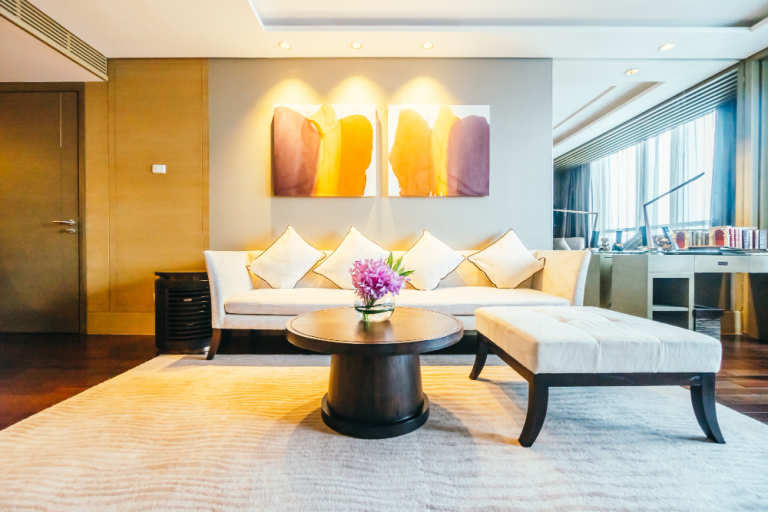
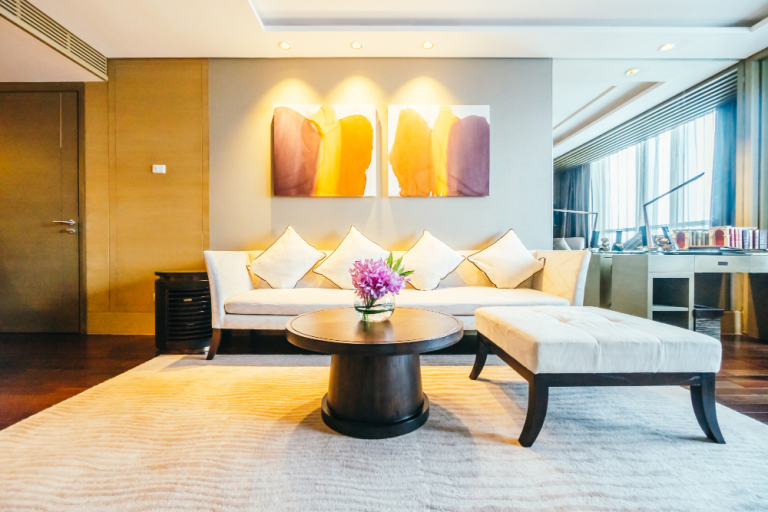
The living room is the heart of a Dhaka apartment — the space where families gather, guests are received, and the quality of a home’s design is most immediately on display. It is also the most difficult room to design well: it must function simultaneously as a relaxation space, an entertainment venue, a reception area for guests, and increasingly a part-time workspace. In a city where apartment floor plates are compact and every square metre must justify its use, living room interior design in Dhaka requires both creative skill and disciplined spatial thinking. This guide covers everything from space planning and style selection to lighting layers and costs — with practical advice grounded in the realities of Dhaka’s housing market.
Space Planning: The Foundation of Every Good Living Room
Before any material or style decision is made, the living room layout must be resolved. Four questions determine everything else.
- Where is the primary focal point? In most Dhaka apartments, the television wall defines the primary orientation of the seating arrangement. In apartments with an exceptional view, the window or glazed wall should take precedence. In rooms without either, a designed focal point — a feature wall, a significant piece of art, a fireplace surround — must be created.
- What is the conversation distance? Seating arranged more than 3.5 metres apart does not encourage natural conversation. In larger living rooms, create two distinct seating zones rather than one oversized arrangement that serves neither purpose well.
- Is there clear circulation? Allow a minimum 90cm clearance between furniture edges for primary routes; 60cm for secondary. Rooms that look spacious in renders often feel cramped once furniture is placed and people begin moving through them.
- Where does storage live? Built-in storage integrated into the design — below window seats, flanking the TV wall, in a full-height joinery unit — is dramatically more space-efficient than freestanding furniture and gives the room a cohesive, designed quality that freestanding pieces cannot achieve.
Six Living Room Styles for Dhaka Apartments
1. Japandi
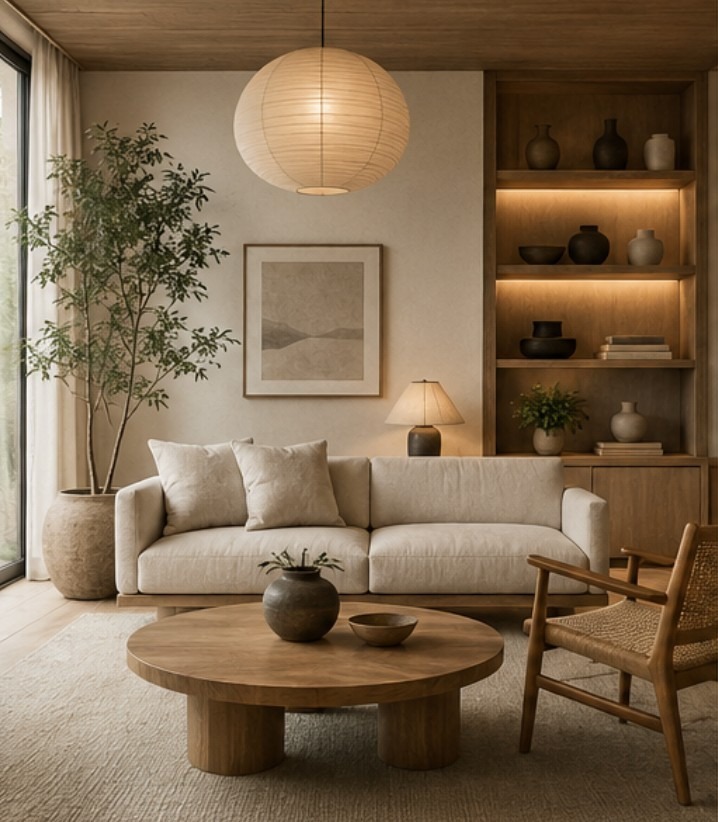
The most requested premium residential style in Dhaka’s current market. Warm plaster walls in cream or greige, solid timber coffee table with rounded organic form, cream linen sofa, natural rattan or timber accent chair, globe pendant or table lamp, built-in timber shelving displaying curated ceramics, a single large indoor plant. Calm, beautiful, and enduring. The editing discipline of Japandi is particularly valuable in compact Dhaka floor plates — the philosophy of fewer, better things applies directly to space-constrained apartments.
Best for: Design-conscious clients who value quality over quantity; apartments with good natural light.
Cost range: Mid-range to premium — the quality of individual pieces matters significantly in this style.
2. Contemporary Minimalist
Clean lines, neutral palette, quality materials, no visual noise. The discipline of minimalism requires abundant, well-designed storage — minimalism without storage is simply mess with nowhere to go. White or very light warm walls, low-profile furniture, concealed storage throughout, precise lighting. The risk in Dhaka’s humid climate: synthetic minimalist materials can look dated as they age. Invest in genuine quality materials that improve with time rather than degrade.
Best for: Couples and professionals without young children; compact apartments where space efficiency is paramount.
Cost range: Budget to premium depending on material quality.
3. Warm Modern
Modern proportions softened by warm colours — terracotta, rust, ochre, sage — tactile materials (boucle fabric, rattan, textured plaster), and layered lighting. The most liveable of contemporary styles and increasingly popular across Dhaka’s middle and upper-middle market. It photographs well, ages gracefully, and provides genuine comfort without sacrificing a contemporary aesthetic. Works in apartments with limited natural light, where warm colours compensate for what daylight cannot provide.
Best for: Families; apartments with limited natural light; anyone who finds pure minimalism cold.
Cost range: Mid-range — warm modern does not require expensive materials to succeed.
4. Classic / Traditional
Rich timber tones, ornate lighting, Chesterfield-style upholstered furniture, patterned rugs, layered curtains, framed art. A style that communicates permanence, heritage, and cultural seriousness — increasingly sought by established families and organisations investing in quality that will last decades rather than years. Requires space to breathe: the classical vocabulary needs generous dimensions to read correctly rather than feeling crowded.
Best for: Large living rooms; clients who value permanence and the classical vocabulary of international luxury.
Cost range: Mid to luxury — quality furniture and materials are essential for this style to succeed.
5. Biophilic
Nature brought deliberately inside: abundant plants at multiple scales, live-edge timber surfaces, natural stone or brick accents, woven textures, colours drawn from the natural world — forest green, terracotta, warm brown, sand. Bangladesh’s tropical climate makes this style particularly easy to maintain: plants thrive with minimal effort, and the abundant natural materials available locally make the palette accessible without the import costs that other premium styles incur.
Best for: Environmentally conscious clients; apartments with terraces or views of greenery; anyone seeking genuine calm in urban Dhaka.
Cost range: Budget to premium — biophilic design does not require expensive materials, but quality natural materials elevate it significantly.
6. Eclectic / Curated
A considered mix of periods, styles, and origins — held together by a consistent colour palette and the evident intentionality of every selection. The hardest style to execute well (the difference between an eclectic room and a chaotic one is invisible until it is not), but the most personal and characterful when it succeeds. Requires a client with genuine aesthetic confidence and a designer with a strong editing hand.
Best for: Confident clients with an existing collection of furniture, art, or objects they wish to incorporate.
Cost range: Highly variable — depends entirely on the pieces chosen.
Lighting: The Single Most Transformative Investment
No design decision transforms a living room more than lighting — and no decision is more commonly underinvested in Bangladesh’s residential market. The standard approach — a single central ceiling fixture — produces flat, unflattering, institutional light that makes every material look ordinary and every evening feel like an office. A well-lit living room uses three layers working in combination:
- Ambient: The overall illumination level. Should be lower than most clients expect — 150–250 lux for evening relaxation — controlled by dimmers. Recessed ceiling downlights on a dimmer circuit provide this layer.
- Task: Localised functional light for reading, working, or crafting. Floor lamps and table lamps positioned beside seating provide this layer without raising the ambient level for the whole room.
- Accent: Directional light highlighting specific features — a piece of art, a plant, a bookshelf. Creates depth and visual interest that flat ambient light cannot produce.
All three layers should be on separate switches or dimmers. The ability to raise and lower each independently — bright for an active family afternoon, dim-warm for an evening with guests — is one of the highest-value investments in any living room design.
Storage: The Invisible Foundation
Living rooms accumulate objects — books, remote controls, charging cables, children’s toys, decorative items — that must be accommodated without visual chaos. The most successful Dhaka living rooms treat storage as a primary design element:
- TV wall joinery: A full-width, floor-to-ceiling unit that frames the television, provides closed storage for electronics, displays books and objects in open shelves, and conceals the cables that destroy even beautifully designed rooms.
- Window seat storage: Where dimensions allow, a built-in window seat with lift-up storage beneath provides comfortable seating, a reading nook, and hidden storage for bulky items in a single footprint.
- Coffee table with storage: A coffee table with interior storage — drawer or lift-top — consolidates remote controls, chargers, coasters, and other table clutter at the room’s most-used surface.
Four Space-Maximising Tricks for Compact Dhaka Living Rooms
- A single dominant rug that defines the seating zone rather than multiple small rugs that fragment the floor plane
- Floor-to-ceiling curtains hung close to the ceiling — the eye reads height, making the room feel taller and more generous
- Furniture with visible legs rather than pieces that sit flush to the floor — the visible floor beneath increases perceived floor area
- Light, warm wall colour that reflects light rather than absorbs it — particularly effective in apartments with limited natural light
Living Room Interior Design Cost — Dhaka 2025
| Room Size | Budget | Mid-Range | Premium |
|---|---|---|---|
| Under 200 sq ft | ৳4L–৳8L | ৳8L–৳16L | ৳16L–৳28L |
| 200–350 sq ft | ৳8L–৳15L | ৳15L–৳28L | ৳28L–৳50L |
| 350–500 sq ft | ৳12L–৳22L | ৳22L–৳40L | ৳40L–৳75L |
| 500+ sq ft | ৳20L–৳38L | ৳38L–৳70L | ৳70L–৳130L+ |
Includes furniture, flooring, lighting fixtures, joinery, and finishing. Excludes structural works and MEP.
Frequently Asked Questions
What is the most common living room design mistake in Dhaka apartments?
Furniture that is too large for the room. Showroom furniture looks right at showroom scale; in a compact Dhaka apartment the same sofa can occupy a disproportionate share of the floor plan and leave inadequate circulation space. Always measure the room and test furniture dimensions in a scaled floor plan before purchasing.
Should the sofa face the TV wall or a different focal point?
In most Dhaka apartments the TV wall is the primary focal point and the sofa should face it directly. If the room has an exceptional view or a designed feature wall worth prioritising, consider positioning the sofa toward that instead with the TV as a secondary orientation. The important thing is a direct face-on relationship — seating that addresses a focal point at an angle creates spatial unease that even excellent furnishing cannot resolve.
How much should I spend on a sofa relative to the total living room budget?
The sofa is the room’s most-used piece of furniture and its visual anchor. Plan to spend 25–35% of the total furniture budget on it. A quality sofa at the right scale, in a material appropriate to Bangladesh’s climate (a linen-cotton blend performs better than pure linen in humidity), will define the room’s character and comfort for a decade.
Can I achieve a premium living room look on a mid-range budget?
Yes — with clear priorities. The highest-impact investments are: a quality sofa (the room’s centrepiece), good lighting (transformative and often underpriced relative to its impact), and one premium material element (a solid timber coffee table, a quality rug, or a well-designed joinery unit). Spending carefully on these three, while using mid-range options elsewhere, produces a room that reads as considered and premium even at mid-range total cost.
Related: Residential Interior Design in Dhaka | Modern Apartment Interior Design | Apartment Renovation Dhaka | Interior Design Cost Guide | Interior Design Trends 2025
Ready to design a living room you actually want to live in? Contact House De Arch — we design homes that work as well as they look.