Why 37% of New Dhaka Restaurants Face Closure Orders Within First Year: The Compliance Reality
Between 2021 and 2023, Dhaka North and South City Corporations issued closure notices to over 340 restaurants for non-compliance with WASA, BSTI, and Fire Service regulations. The average penalty for operating without proper permits ranges from BDT 2 lakh to 8 lakh, excluding the cost of retrofitting designs that should have been compliant from day one.
The critical error most F&B entrepreneurs make: treating compliance as an afterthought rather than a design prerequisite. A restaurant that passes all inspections isn’t lucky—it’s intentionally designed around Bangladesh’s regulatory framework from the first AutoCAD line.
This comprehensive guide covers the eight non-negotiable compliance requirements every Dhaka restaurant owner must integrate into their design before breaking ground. House De Arch has navigated these approvals for commercial F&B projects across Dhaka, Chattogram, and Sylhet, and the pattern is clear: restaurants designed with compliance in mind open 4-6 months faster than those scrambling for permits mid-construction.
1. WASA Water Connection and Grease Trap Requirements: BDT 35,000-1.2 Lakh Depending on Capacity
Dhaka WASA mandates separate commercial water connections for restaurants, and the approval process scrutinizes your wastewater management plan before issuing NOC (No Objection Certificate).
WASA Restaurant Connection Requirements:
- Water demand calculation: Minimum 1,500 liters/day for restaurants under 50 seats; 3,000+ liters/day for 100+ seat establishments. WASA requires stamped calculations from a registered engineer.
- Mandatory grease trap installation: All commercial kitchens must install grease interceptors complying with WASA specifications (minimum 1,000-liter capacity for standard restaurants, 2,500+ liters for hotel restaurants). Non-compliance results in connection refusal.
- Separate drainage line: Kitchen wastewater cannot merge with general sewage before grease trap treatment. WASA inspectors verify plumbing layouts during site visits.
- Connection fees: BDT 35,000-75,000 for standard restaurants (up to 100 seats), BDT 1.2-2.5 lakh for larger F&B establishments with multiple kitchen zones.
Approval Timeline: 6-10 weeks if drawings are WASA-compliant from submission; 14-20 weeks if revisions required. Many restaurants lose 3-4 months here because architects unfamiliar with WASA’s latest grease trap specifications (updated in 2022) submit non-compliant plans.
Design Integration: Grease traps require 8-12 square feet of dedicated space, typically below-grade or in service yards. Your restaurant interior design in Dhaka must account for this from initial space planning—retrofitting is expensive (BDT 80,000-1.5 lakh) and often architecturally impossible in multi-story buildings.
2. BSTI Food License and Kitchen Design Standards: The 14-Point Inspection Checklist
Bangladesh Standards and Testing Institution (BSTI) approval is legally mandatory before Dhaka City Corporation issues your trade license. BSTI restaurant approval Bangladesh process involves physical kitchen inspection against 14 specific criteria.
BSTI Restaurant Kitchen Design Requirements:
- Floor-to-ceiling tiles in food prep zones: Minimum 6 feet height, washable ceramic tiles (not paint). Grouting must be epoxy-based, not cement.
- Stainless steel work surfaces: Food-grade SS304 minimum. Wooden cutting boards allowed only if replaced quarterly with documentation.
- Separate raw/cooked food zones: Physical separation (minimum 4 feet) or separate rooms for raw meat handling vs. cooked food assembly.
- Handwashing stations: Minimum two sinks dedicated to handwashing (not dish-washing), with soap dispensers and paper towel holders within arm’s reach.
- Waste segregation system: Color-coded bins (organic, recyclable, hazardous) with foot-operated lids. BSTI checks for proper placement away from food prep.
- Ventilation and exhaust: Commercial kitchen hoods with minimum 800 CFM extraction capacity, ducted to exterior (not recirculating). BSTI measures airflow during inspection.
- Pest control measures: Mesh screens on all windows, door sweeps, quarterly pest control contract (BSTI requests documentation).
- Staff facilities: Separate changing room, staff toilet (cannot be customer toilet), locker storage.
- Water filtration: Drinking water must pass through approved filtration. BSTI requests water test certificates (from BSTI-approved labs).
- Refrigeration: Commercial refrigeration with thermometers visible on exterior. BSTI checks temperature logs during inspection.
- Lighting: Minimum 200 lux in food prep areas, shatterproof LED fixtures (no exposed bulbs over food).
- First aid kit: Must be present in kitchen, stocked, and accessible.
- Fire safety equipment: ABC-type fire extinguishers within 10 feet of cooking equipment (BSTI checks this even though Fire Service has separate inspection).
- Floor drainage: Minimum 1:50 slope toward drains, drain covers removable for cleaning, anti-slip flooring (ceramic with minimum R10 rating).
Application Process: Submit kitchen layout drawings (stamped by architect), equipment list, water test certificates, and pest control contract. Fee: BDT 5,000-12,000 depending on restaurant category. Inspection scheduled 3-5 weeks post-application. Pass rate on first inspection: approximately 40%—most failures due to inadequate ventilation or improper waste handling setup.
Penalty for Operating Without BSTI Approval: BDT 50,000-3 lakh fine plus immediate closure notice. City Corporations now cross-check BSTI approval before trade license renewal, so this isn’t optional.
3. Fire Service NOC: Why 60% of Restaurant Designs Fail the First Inspection
Bangladesh Fire Service and Civil Defence issues restaurant fire safety compliance Dhaka certificates after verifying life safety systems. Their rejection rate for commercial kitchens is approximately 60% on first submission—primarily due to architects treating fire compliance as equipment purchase rather than integrated design.
Fire Service Restaurant Requirements:
- Fire-rated kitchen separation: Commercial kitchens must be separated from dining areas by minimum 1-hour fire-rated walls (12-inch brick or equivalent fire-rated partition). Openings limited to service windows with fire shutters.
- Kitchen suppression system: Wet chemical fire suppression system (NOT just extinguishers) mandatory for kitchens with deep fryers, tandoors, or charcoal grills. System cost: BDT 1.8-4.5 lakh depending on kitchen size. Must be installed by Fire Service-approved vendors.
- Emergency exits: Minimum two exits from dining area if capacity exceeds 50 persons. Exits must be 1 meter wide minimum, doors must swing outward, panic hardware required.
- Exit signage and emergency lighting: Illuminated exit signs (with battery backup) every 15 meters. Emergency lights activating on power failure. Fire Service tests these during inspection.
- Fire extinguisher placement: ABC-type, 9kg minimum, maximum 20-meter travel distance from any point in restaurant. Kitchen requires minimum two extinguishers plus suppression system.
- Gas line compliance: LPG lines must be copper or CSST (corrugated stainless steel tubing), not rubber hose. Manual shutoff valve required within 3 feet of each appliance, plus master shutoff accessible from outside kitchen. Fire Service checks gas installation thoroughly—this is where most retrofits happen.
- Electrical panel separation: Electrical distribution panels cannot be inside kitchen. Must be in separate fire-rated enclosure with self-closing door.
- Occupancy calculation: Fire Service calculates based on 1.5 square meters per person for dining area. Your stated capacity must match. Overstating triggers requirement for additional exits/fire systems.
Approval Timeline: 8-12 weeks if design is compliant. Fire Service conducts pre-NOC consultation (recommended—fee BDT 3,000-5,000) where they review drawings before formal submission. Restaurants skipping this step face 75% rejection rate.
Cost of Non-Compliance: Retrofitting fire-rated walls mid-construction: BDT 1.2-2.8 lakh. Redesigning exits after walls are built: BDT 800,000-1.5 lakh. Installing suppression system after equipment placement: BDT 2.5-5 lakh (vs. BDT 1.8-4.5 lakh if integrated during design).
4. Trade License from Dhaka City Corporation: The Final Approval That Requires All Others
Your trade license restaurant Dhaka cannot be issued until you present NOCs from WASA, BSTI, Fire Service, and (if applicable) RAJUK. City Corporations updated requirements in 2023, adding stricter documentation checks.
Trade License Application Requirements:
- Holding tax receipt (paid current)
- Rent agreement or ownership deed (notarized)
- WASA water connection documents and grease trap installation certificate
- BSTI food license (physical certificate, not just application receipt)
- Fire Service NOC (must be current—expires after 1 year)
- TIN certificate (restaurant owner/company)
- Recent passport-size photographs and NID copies
- Signboard design approval (from City Corporation’s signboard department—often overlooked; fee BDT 2,000-8,000 depending on signboard size)
Fee Structure (2024): BDT 12,000-25,000 for standard restaurants (50-100 seats), BDT 30,000-60,000 for larger establishments or prime locations (Gulshan, Banani, Dhanmondi). Renewal required annually; late renewal penalty is 50% of base fee.
Processing Time: 3-4 weeks if all NOCs are in order. City Corporations now verify BSTI and Fire Service approvals electronically, reducing fraud but increasing rejection rate for incomplete applications (65% of first-time applications require resubmission due to missing NOCs).
Design Implication: You cannot legally operate, cannot install gas lines, cannot get electrical load approval until trade license is issued. Restaurants that start construction before securing pathway to trade license face average 6-month delays. Those that design with all approval requirements in mind from day one typically open within 4-5 months of construction start.
5. Gas Connection from Titas Gas: Kitchen Layout Requirements for Approval
Titas Gas Transmission and Distribution Company (or Jalalabad Gas in some areas) requires commercial gas connection approval based on your kitchen’s fire safety design and ventilation adequacy.
Titas Gas Commercial Connection Requirements:
- Kitchen ventilation certification: Titas requires proof of adequate exhaust (minimum 30 air changes per hour for commercial kitchens). Your MEP (mechanical, electrical, plumbing) consultant must submit CFM calculations stamped by a registered engineer.
- Approved gas line installer: Titas maintains list of approved contractors. DIY installations are rejected. Installation cost: BDT 45,000-1.2 lakh depending on distance from main line and BTU load.
- Equipment BTU calculation: You must provide manufacturer specifications for all gas appliances (stoves, tandoors, ovens). Titas sizes meter and regulator accordingly. Under-calculation leads to insufficient gas pressure; over-calculation increases monthly fees.
- Fire Service NOC: Titas will not process application without current Fire Service NOC showing gas line approval.
- Dedicated gas room (for large restaurants): Establishments with 200,000+ BTU/hr aggregate load must install gas meters in separate ventilated room with explosion-proof electrical fixtures.
Timeline: 6-10 weeks post-application if all documents are in order. Connection fee: BDT 18,000-35,000 for standard restaurants. Monthly demand charge (regardless of usage): BDT 800-2,500 depending on sanctioned load.
Why This Matters for Design: Gas appliance placement determines gas line routing, which affects Fire Service approval, which affects where you can locate your kitchen. Restaurants designed by firms unfamiliar with Titas requirements often discover mid-construction that their kitchen layout requires gas lines running through dining areas (prohibited) or external routing that adds BDT 80,000-1.5 lakh to budget.
6. Environmental Clearance (for Large F&B Operations): Department of Environment NOC
Restaurants exceeding 200 seats or operating as part of hotel/resort complexes require Environmental Clearance Certificate from Department of Environment (DoE) before construction begins.
When DoE Approval is Mandatory:
- Restaurant seating capacity 200+ persons
- Restaurant with on-site food processing (e.g., bakery, butchery, large-scale prep kitchen serving multiple outlets)
- Waterfront location (rivers, lakes—additional scrutiny for wastewater discharge)
- Restaurant within environmentally sensitive areas (DoE maintains list; includes parts of Gulshan Lake vicinity, Hatirjheel perimeter)
DoE Assessment Focus: Wastewater treatment plan, solid waste management, noise levels (outdoor dining areas), air quality (kitchen exhaust must not violate particulate matter standards). DoE may require Environmental Impact Assessment (EIA) for larger projects—cost BDT 1.5-4 lakh, timeline 12-16 weeks.
Application Fee: BDT 10,000-50,000 depending on project category. Non-compliance penalty: BDT 2 lakh-10 lakh plus project suspension.
Design Consideration: DoE approval requires stamped drawings showing grease trap placement, wastewater treatment (if not connected to WASA), exhaust chimney height and filtration. Restaurants planned without DoE consultation in sensitive areas face 100% rejection rate—we’ve seen projects restart from zero after 6 months of non-compliant construction.
7. Food Handler Training and Health Certificates: Often Overlooked Until BSTI Inspection
While technically an operational requirement, BSTI restaurant approval Bangladesh process now includes verification that restaurant management has completed food safety training and kitchen staff possess health certificates from City Corporation health departments.
Requirements:
- Food safety training: Minimum one manager must complete BSTI-approved food safety course (3-day program, cost BDT 5,000-8,000 per person). Certificate valid 3 years.
- Kitchen staff health certificates: All kitchen staff must undergo annual health screening (tuberculosis, typhoid, hepatitis tests) from City Corporation health centers. Cost: BDT 500-1,000 per person. BSTI requests these during inspection.
- Vaccination records: Some City Corporations now requiring hepatitis B vaccination for kitchen staff. Requirements vary by zone.
Design Implication: While not affecting physical design, restaurants opening without factoring in 3-4 weeks for staff certification face delays in final BSTI approval even if kitchen design is perfect. Smart operators schedule training during fit-out phase so certificates are ready for inspection.
8. Signboard and Outdoor Seating Permits: City Corporation’s Underestimated Requirements
Dhaka North and South City Corporations regulate restaurant signboards and any outdoor/rooftop seating. Non-compliant signage triggers fines; unpermitted outdoor seating leads to removal notices.
Signboard Requirements:
- Application required before installation (fee BDT 2,000-8,000 depending on size and illumination)
- Size limits based on building facade width and setback from road
- Illuminated signs require electrical safety certificate
- Bangla text must be equal or larger than English (City Corporation enforcement increasing on this)
- Annual renewal required (BDT 1,500-3,000)
Outdoor/Rooftop Seating Permits:
- Structural safety certificate from registered engineer (confirming roof can support occupancy load)
- Fire Service approval for rooftop seating (emergency exit requirements change)
- City Corporation outdoor seating permit if seating extends onto footpath (fee BDT 5,000-15,000 annually; some areas prohibit entirely)
- Compliance with noise ordinances (outdoor music generally prohibited after 10 PM in residential zones)
Penalty for Non-Compliance: Signboard removal plus BDT 10,000-50,000 fine. Unauthorized rooftop operation can trigger building-wide inspection potentially uncovering other violations.
Design Integration: If your restaurant interior design includes rooftop seating as core concept, structural approval and fire exits must be factored from initial architectural drawings, not treated as afterthought. Retrofitting rooftop egress stairs after construction: BDT 3-8 lakh.
The Real Cost of Non-Compliance: A Timeline and Budget Comparison
Let’s examine two hypothetical 80-seat restaurants in Dhanmondi, both with BDT 60 lakh construction budgets:
Restaurant A: Compliance-First Design (House De Arch Approach)
- Month 1-2: Pre-design consultation with WASA, Fire Service, BSTI. Architectural drawings incorporate all requirements (grease trap space, fire-rated walls, proper exits, exhaust systems). Consultancy service investment: BDT 80,000-1.5 lakh.
- Month 2-3: Simultaneous application to all agencies with compliant drawings.
- Month 3-6: Construction proceeds while approvals process. Minor design adjustments if required (typically 5-10% of cases).
- Month 6: Trade license issued. Restaurant opens on schedule.
- Total timeline: 6 months from design to opening.
- Compliance costs: BDT 2.8-4.2 lakh (WASA connection, BSTI license, Fire Service systems integrated into initial construction, gas connection, permits).
- Total project cost: BDT 62.8-64.2 lakh.
Restaurant B: Compliance-as-Afterthought Design
- Month 1-4: Construction begins with generic kitchen design. No pre-consultation with regulatory agencies.
- Month 4: WASA rejects connection application—no grease trap space in design. Retrofit required: break floor, install underground tank, re-plumb. Cost: BDT 1.2 lakh. Delay: 3 weeks.
- Month 5: BSTI inspection fails—kitchen lacks separate raw food zone, ventilation CFM inadequate, no fire-rated wall separating kitchen from dining. Retrofit: add partition wall, upgrade exhaust system. Cost: BDT 2.8 lakh. Delay: 6 weeks.
- Month 6: Fire Service rejects—gas lines don’t meet standards, single exit for 80-seat capacity, no suppression system. Retrofit: re-route gas lines, cut new exit door through exterior wall (building permission required, additional fee), install suppression system. Cost: BDT 4.2 lakh. Delay: 8 weeks.
- Month 8: Trade license finally issued after all NOCs obtained.
- Total timeline: 11 months from design to opening (5-month delay).
- Compliance costs: BDT 8.2 lakh (includes BDT 4 lakh in retrofits that wouldn’t have been necessary with proper design).
- Opportunity cost: 5 months of rent paid with zero revenue: BDT 6-8 lakh (assuming BDT 1.2-1.6 lakh/month rent in Dhanmondi).
- Total project cost: BDT 74.2-78.2 lakh (22-27% over budget).
This isn’t hypothetical fear-mongering—House De Arch has consulted on eight restaurant projects in the past 18 months where owners approached us mid-construction after failed inspections. Average retrofit cost: BDT 3.2-6.5 lakh. Average delay: 4-7 months.
How House De Arch Integrates Compliance Into Restaurant Design From Day One
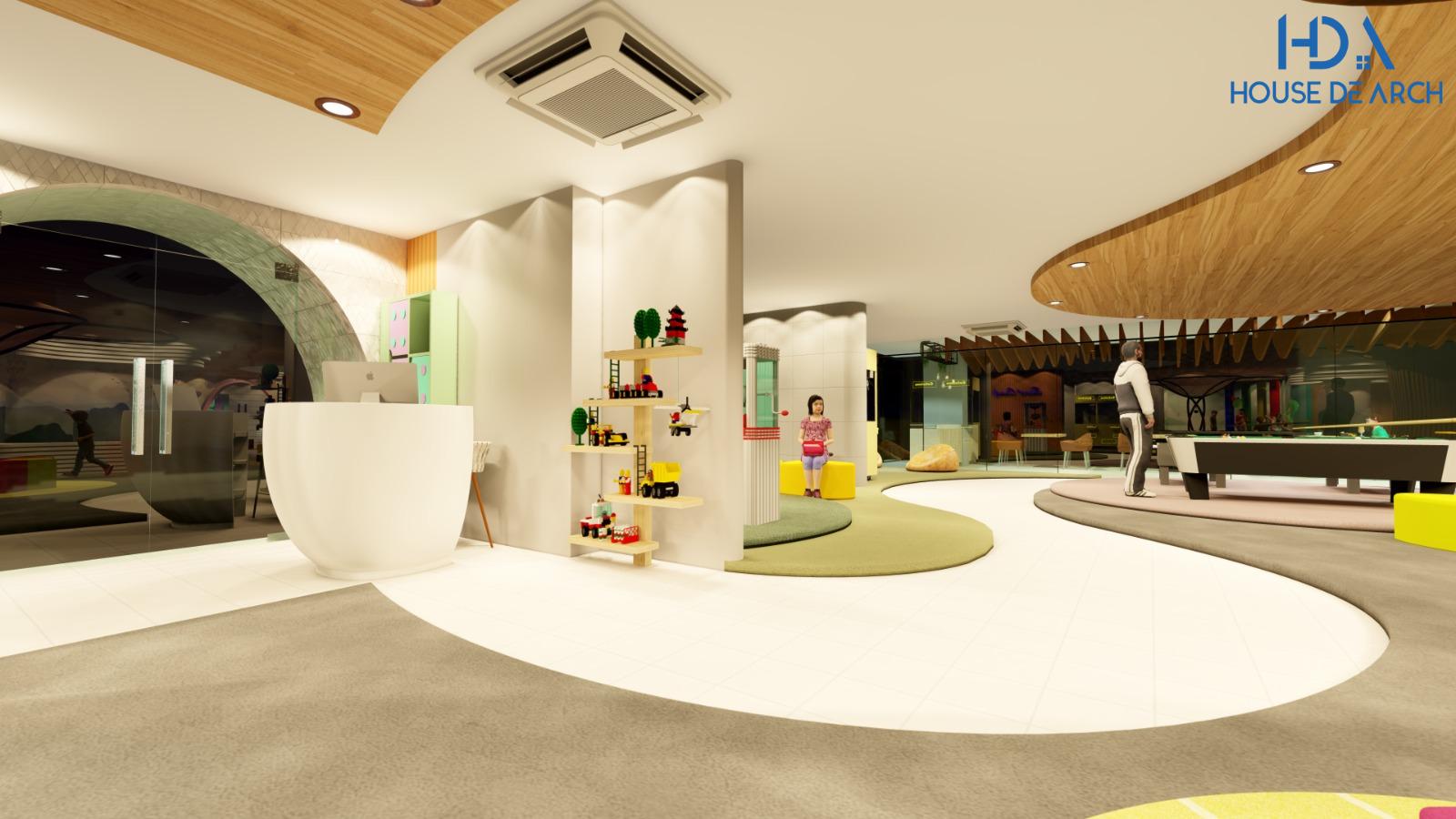
Our restaurant interior design in Dhaka process doesn’t treat compliance as separate from design—it’s the framework within which creative design happens. Here’s what makes our approach different:
Pre-Design Regulatory Audit (Week 1-2): Before drawing a single line, we conduct site-specific regulatory research. What is the WASA grease trap requirement for your specific location and expected water usage? What is Fire Service’s current interpretation of exit requirements for your building type (mixed-use buildings have different standards than standalone)? What are City Corporation’s signboard rules for your specific road? This research costs 30-40 hours of professional time, but it prevents 100% of mid-construction surprises.
Integrated MEP and Interior Design (Week 2-6): Our architects don’t design spaces and then “hand off” to MEP engineers. Kitchen layouts, dining area configurations, restroom locations are designed simultaneously with plumbing, HVAC, electrical, and fire suppression systems. This is why our restaurants pass Fire Service inspection at 85% rate on first submission vs. industry average of 40%.
Pre-Submission Regulatory Consultation (Week 5-7): We submit preliminary drawings to WASA, Fire Service, and BSTI for informal review before formal applications. Cost: BDT 3,000-5,000 per agency. Value: identifying issues when they’re lines on paper (changeable in 2 days) rather than built walls (changeable in 2 months and BDT 2 lakh).
Application Management (Week 6-20): We submit all applications simultaneously and manage follow-ups. Our project management team tracks approval timelines and proactively addresses inspector queries. Most architecture firms submit applications and disappear—clients only discover problems when permits are denied.
Construction Oversight with Compliance Verification (Month 3-6): During construction, our site supervision specifically verifies compliance elements: grease trap installed per WASA spec? Fire-rated wall built with correct materials? Gas lines routed per approved drawings? Exhaust CFM verified with testing? This prevents the common scenario where contractors “value-engineer” (read: cut corners on) compliance elements to save money, causing inspection failures later.
Pre-Opening Inspection Preparation (Week 20-24): Before official inspections, we conduct internal inspections using actual BSTI and Fire Service checklists, addressing any issues. We schedule BSTI food safety training for management during fit-out phase so certificates are ready. We coordinate all final inspections to happen within a 2-week window, minimizing delays between final approval and opening.
Restaurant Permits Dhaka: Complete Timeline Roadmap (With Parallel Processing Strategy)
The mistake most restaurant owners make is linear thinking: “First I’ll get WASA approval, then BSTI, then Fire Service…” That’s a 40-week process. Smart approach: parallel processing where legally permissible.
Optimal F&B Permit Timeline Dhaka (24-28 Weeks from Design to Opening):
Weeks 1-6: Design Phase with Regulatory Integration
- Site analysis and regulatory research
- Concept development within compliance constraints
- Preliminary drawings with MEP integration
- Pre-consultation with WASA, Fire Service, BSTI (informal)
- Design refinement based on feedback
- Final stamped drawings prepared
Weeks 6-8: Simultaneous Application Submission
- WASA water connection application (Week 6)
- Fire Service NOC application (Week 6)
- DoE application if required (Week 6—runs parallel but takes longer)
- Titas Gas connection application (Week 7, requires Fire Service acknowledgment but not full NOC)
- BSTI food license application (Week 8, after kitchen design is finalized in coordination with Fire Service feedback)
Weeks 8-20: Construction with Active Permit Follow-Up
- Construction begins on non-controversial elements (dining area structural work, preliminary plumbing rough-in)
- Hold critical compliance elements (final grease trap installation, fire-rated wall construction, gas line installation) until preliminary agency feedback received
- Active follow-up on all applications (weekly status checks)
- Respond to agency queries within 24-48 hours (delayed responses add 2-4 weeks each time)
- Fire Service site inspection (typically Week 14-16): address any issues immediately
- WASA site inspection (typically Week 12-14): verify grease trap installation compliance
- Titas Gas connection completion (Week 16-18)
Weeks 18-22: Final Approvals and Trade License
- BSTI kitchen inspection (Week 18-19, after kitchen is substantially complete)
- Fire Service NOC issued (Week 18-20)
- WASA connection approval (Week 18-20)
- Trade license application submission (Week 20, with all NOCs)
- Signboard permit application (Week 20)
- Trade license issued (Week 22-24)
Weeks 22-28: Final Fit-Out and Soft Opening
- Equipment installation and testing
- Staff hiring and food safety training
- Soft opening with invited guests (verifies operations before public opening)
- Official opening (Week 26-28)
This timeline assumes competent design and responsive management. Delays typically occur at: WASA grease trap inspection (if installation doesn’t match approved drawings), Fire Service final inspection (if contractors deviated from approved fire safety systems), BSTI kitchen inspection (if equipment or layout changed from approved plans).
Common Compliance Mistakes That Cost Dhaka Restaurants BDT 2-8 Lakh (And How to Avoid Them)
Mistake #1: Undersized Grease Trap
Contractors often install 500-liter grease traps when WASA requires 1,000+ liters, thinking “it’s cheaper and inspectors won’t notice.” WASA inspectors measure capacity. Retrofit requires excavation, new tank, re-plumbing. Cost: BDT 80,000-1.5 lakh. Time: 3-4 weeks.
Mistake #2: Painted Kitchen Walls Instead of Tiles
“We’ll use washable paint, it looks cleaner”—until BSTI inspection fails you. BSTI requires tiles minimum 6 feet height in food prep areas. Retrofit: remove paint, install tiles, re-grout. Cost: BDT 45,000-85,000 for 250 sq ft kitchen. Time: 2 weeks plus curing time.
Mistake #3: Recirculating Kitchen Hood Instead of Ducted Exhaust
Recirculating hoods are cheaper (BDT 80,000 vs. BDT 2.5 lakh for ducted) but don’t meet BSTI CFM requirements or Fire Service safety standards. Retrofit requires cutting through walls/roof for ductwork—often architecturally impossible in mid-building restaurants. Cost when feasible: BDT 3.5-5.5 lakh. When not feasible: restaurant cannot operate.
Mistake #4: Rubber Gas Hoses Instead of Copper/CSST Lines
Rubber hoses are standard in residential kitchens but prohibited in commercial by Fire Service. Retrofit: re-plumb entire gas system. Cost: BDT 1.2-2.8 lakh. Time: 3 weeks.
Mistake #5: Single Exit for 60+ Seat Restaurant
Fire Service requires two exits for 50+ occupancy. Many restaurants try to argue “we’ll limit to 49 seats”—but Fire Service calculates based on floor area (1.5 sqm per person), not stated capacity. If your dining area is 120 sqm, that’s 80 capacity regardless of how many chairs you install. Adding a second exit mid-construction requires cutting through exterior wall (structural approval required), adding stairs if upper floor, installing proper exit hardware. Cost: BDT 2.5-6 lakh. Time: 6-8 weeks including approvals.
Mistake #6: Starting Construction Before Any Permits
“We’ll apply for permits while building”—until City Corporation issues stop-work notice after neighbor complaint. Stop-work orders add 8-16 weeks to timeline while you obtain all NOCs before permission to resume. Some contractors continue working despite stop-work orders, risking demolition orders.
The ROI of Compliance-First Design: Why It’s Not Just Risk Mitigation, It’s Business Strategy
Restaurant owners often perceive compliance as pure cost with no return. That’s wrong. Compliance-first design delivers measurable ROI:
Faster Time-to-Revenue: 5-6 month opening vs. 11-13 month delayed opening means 6-7 months of revenue generation. For restaurant averaging BDT 8 lakh monthly revenue, that’s BDT 48-56 lakh additional revenue in Year 1. Even if compliance-first design costs BDT 1.5 lakh more upfront, the 32x ROI is obvious.
Lower Insurance Premiums: Restaurants with documented Fire Service compliance and proper fire suppression systems receive 15-25% lower commercial insurance premiums. On BDT 80 lakh insured value, that’s BDT 60,000-1.2 lakh annual savings.
Higher Sale/Lease Value: Fully compliant restaurants with transferable permits command 20-35% premium in sale transactions vs. restaurants operating on expired licenses or temporary permits. Investors pay premium for compliance certainty.
Bank Loan Approval: Banks increasingly require proof of compliance (trade license, Fire Service NOC, BSTI approval) before approving restaurant loans or working capital. Non-compliant restaurants face loan rejection or higher interest rates (2-4% premium).
Franchise and Chain Expansion: National/international F&B franchises require comprehensive compliance documentation before awarding franchises. Restaurant brands expanding to multiple locations find that first-location compliance infrastructure (standardized kitchen design, documented approval process, agency relationships) accelerates subsequent locations by 40-60%.
Bottom line: compliance-first design isn’t overhead—it’s operational infrastructure that directly impacts profitability, scale-ability, and enterprise value.
Start Your Restaurant Project with Regulatory Certainty: House De Arch’s Compliance-Integrated Design Process
Every restaurant project we undertake at House De Arch begins with three questions:
1. What regulatory approvals will this specific location and concept require?
2. How do we design a space that passes every inspection on first submission?
3. How do we achieve this without compromising the brand experience or aesthetic vision?
Our commercial design projects across Dhaka, Chattogram, and Sylhet have proven that regulatory compliance and compelling design aren’t trade-offs—they’re integrated outcomes of proper planning.
If you’re planning a restaurant, café, cloud kitchen, or any F&B venture in Dhaka or elsewhere in Bangladesh, the decision point isn’t whether to prioritize compliance—it’s whether to integrate compliance intelligently from day one or pay for retrofits later. The difference: BDT 3-6 lakh and 4-6 months.
We offer two service models:
Full Design-Build: From concept through permitting, construction, and opening. Our plans and pricing structure includes dedicated compliance management as standard, not optional add-on.
Compliance Audit and Remediation: Already under construction or operating with permit issues? We conduct regulatory audits identifying specific violations and design cost-effective remediation strategies. Fee: BDT 45,000-85,000 depending on project size. Typical remediation saves 40-60% vs. full reconstruction.
Contact House De Arch for a preliminary compliance consultation. We’ll assess your specific location, concept, and timeline, providing honest feedback on regulatory pathway and associated costs. First consultation (60-90 minutes): complimentary for serious projects targeting construction start within 6 months.
Let’s build your restaurant right the first time—compliant, beautiful, and profitable. Reach out via our contact page or call our Dhaka office to schedule your compliance-focused design consultation.
FAQ
What is the minimum timeline to get all restaurant permits in Dhaka?
With simultaneous application submission and compliant designs, the minimum timeline from application to all final approvals is 18-22 weeks. This includes WASA water connection (6-10 weeks), Fire Service NOC (8-12 weeks), BSTI food license (4-6 weeks), and City Corporation trade license (3-4 weeks). The parallel processing approach saves approximately 12-18 weeks compared to sequential applications. However, this assumes zero revisions—non-compliant initial designs can extend timelines to 35-45 weeks.
How much does it cost to get all necessary permits for a restaurant in Dhaka?
For a standard 60-80 seat restaurant, expect total permit and connection costs of BDT 2.8-4.5 lakh, broken down approximately as: WASA connection (BDT 35,000-75,000), BSTI food license (BDT 5,000-12,000), Fire Service consultation and NOC processing (BDT 5,000-15,000), Titas Gas connection (BDT 18,000-35,000), trade license (BDT 12,000-25,000), signboard permit (BDT 2,000-8,000), plus mandatory infrastructure (grease trap installation BDT 80,000-1.5 lakh, fire suppression system BDT 1.8-4.5 lakh). These infrastructure costs are often mistakenly viewed as separate from permitting but are mandatory for approval.
Can I operate a restaurant in Dhaka without BSTI approval?
No. Operating without BSTI approval is illegal and carries penalties of BDT 50,000-3 lakh plus immediate closure notice. Since 2022, Dhaka City Corporations cross-check BSTI approval status before issuing or renewing trade licenses, making it impossible to maintain legal operation without BSTI certification. Additionally, food delivery platforms (Foodpanda, Pathao Food) increasingly require BSTI documentation before onboarding restaurants.
What happens if my restaurant fails Fire Service inspection?
Fire Service issues a deficiency notice specifying violations (typically inadequate exits, missing fire suppression systems, non-compliant gas installations, or lack of fire-rated separation). You have 30-60 days to remediate and request re-inspection. Failure to remediate results in formal rejection, preventing trade license issuance. Common remediation costs: adding emergency exit (BDT 2.5-6 lakh), installing kitchen suppression system (BDT 1.8-4.5 lakh), upgrading gas lines (BDT 1.2-2.8 lakh), installing fire-rated wall (BDT 1.2-2.8 lakh). Re-inspection fee: BDT 3,000-5,000.
Do I need separate architect and interior designer for restaurant compliance, or can one firm handle everything?
A qualified architecture and interior design firm like House De Arch can handle all design and compliance aspects—architectural layout, MEP (mechanical, electrical, plumbing) coordination, interior fit-out, and regulatory applications. The advantage of single-firm responsibility is integrated compliance: kitchen equipment selection coordinated with exhaust requirements, dining layout coordinated with exit paths, plumbing design coordinated with WASA grease trap specs. Split responsibility (architect for structure, interior designer for fit-out) often creates gaps where neither party owns compliance integration, leading to inspection failures.
Is it possible to get restaurant permits for a building that doesn’t have RAJUK approval?
Technically no—City Corporations require building completion certificate (which requires RAJUK approval) before issuing trade licenses for new buildings. However, for existing buildings built before strict RAJUK enforcement, it’s sometimes possible to obtain restaurant permits if the building has utility connections (WASA, electricity, gas) and holding tax receipts. Each case is location-specific. Banani, Gulshan, and Dhanmondi have stricter enforcement than peripheral areas. Risk: operating in non-RAJUK-approved building means eviction vulnerability if demolition orders are issued. Due diligence essential before signing lease.