Why Office Design Directly Impacts Productivity in Dhaka’s Commercial Market
Research from the World Green Building Council demonstrates that well-designed office environments increase productivity by 22-35%, reduce absenteeism by 15%, and improve employee retention by up to 27%. For Dhaka businesses operating in competitive sectors—fintech, software development, marketing agencies, corporate headquarters—these metrics translate directly to bottom-line impact.
In Bangladesh’s commercial real estate context, where average office rental costs in Gulshan, Banani, and Motijheel range from BDT 45-85 per sq ft monthly, investing BDT 450-750 per sq ft in strategic office interior design in Dhaka delivers measurable ROI through reduced turnover costs (estimated at 6-9 months’ salary per employee in Bangladesh) and increased output per workstation.
This guide provides the complete framework House De Arch uses for 2,500-4,000 sq ft office projects—covering space planning ratios, lighting specifications, acoustic treatments, and material selections calibrated for Dhaka’s climate, BNBC requirements, and local procurement realities.
The Productivity Framework: Four Interdependent Design Systems
Productive office design Dhaka strategies rest on four evidence-based pillars that we address simultaneously in every commercial project:
- Spatial Organization: Zone planning, circulation efficiency, workstation density calibrated to task type
- Lighting Design: Natural light optimization, task lighting, circadian rhythm support
- Acoustic Control: Sound masking, absorption materials, zone separation
- Material & Climate Strategy: Thermal comfort, air quality, maintenance durability for Dhaka conditions
Each system contributes independently to productivity metrics, but their integration produces multiplicative effects. A well-lit workspace loses effectiveness if acoustic distractions persist; excellent zoning fails if thermal discomfort drives employees away from optimal workstations.
Space Planning Strategy for 2,500-4,000 sq ft Dhaka Offices
For office space planning Dhaka projects in this size range, we typically accommodate 25-45 employees depending on functional requirements. The productivity-optimized allocation differs significantly from conventional ‘maximize desks’ approaches:
Evidence-Based Zone Allocation
Focus Work Zones (40-45% of usable area): Individual workstations requiring concentration. Allocate 70-85 sq ft per workstation including circulation—significantly more than the 50-60 sq ft industry average. This prevents perceived crowding, which studies show reduces cognitive performance by 12-18%.
Collaborative Zones (25-30%): Meeting rooms (8-12 person capacity), informal collaboration areas with movable furniture, project war rooms. Bangladesh corporate culture increasingly values team-based work; we design 2-3 distinct collaboration spaces with varied acoustic and visual privacy levels.
Support & Amenity Zones (15-20%): Pantry/kitchen, prayer room (BNBC requirement for offices >2,000 sq ft), storage, server room with dedicated cooling. These directly impact employee satisfaction scores, which correlate 0.78 with productivity metrics.
Circulation & Flexibility (10-15%): Corridors, transition zones, and deliberately underutilized spaces that permit future reconfiguration without full renovation. For Dhaka’s rapidly evolving business environment, this prevents obsolescence.
Workstation Configuration by Department Function
Office interior design Bangladesh productivity strategies require matching spatial design to cognitive load:
- Software Development/Finance (high concentration tasks): Minimum 80 sq ft per workstation, acoustic panels between desks, positioned away from high-traffic circulation. 60-70% of these teams should have access to natural light.
- Sales/Marketing (collaborative, phone-intensive): 65-75 sq ft per workstation, clustered in acoustically separated zone with sound-absorbing ceiling treatment and enclosed phone booths (2-3 booths per 15 employees).
- Management/HR: Private or semi-private offices, 120-150 sq ft, positioned for visual oversight of workspace without constant auditory exposure to operational noise.
For mixed-function teams common in Dhaka startups and SMEs, we design ‘gradient zoning’—transitioning from quiet focus areas to progressively more collaborative zones, allowing employees to self-select appropriate environments throughout the workday.
Office Lighting Design Bangladesh: The 22% Productivity Variable
Lighting is the single highest-impact variable in our productivity testing—properly designed systems deliver 18-22% performance improvements in knowledge work. For Dhaka offices, this requires balancing abundant natural light with intense glare, high cooling loads, and frequent power interruptions.
Natural Light Optimization
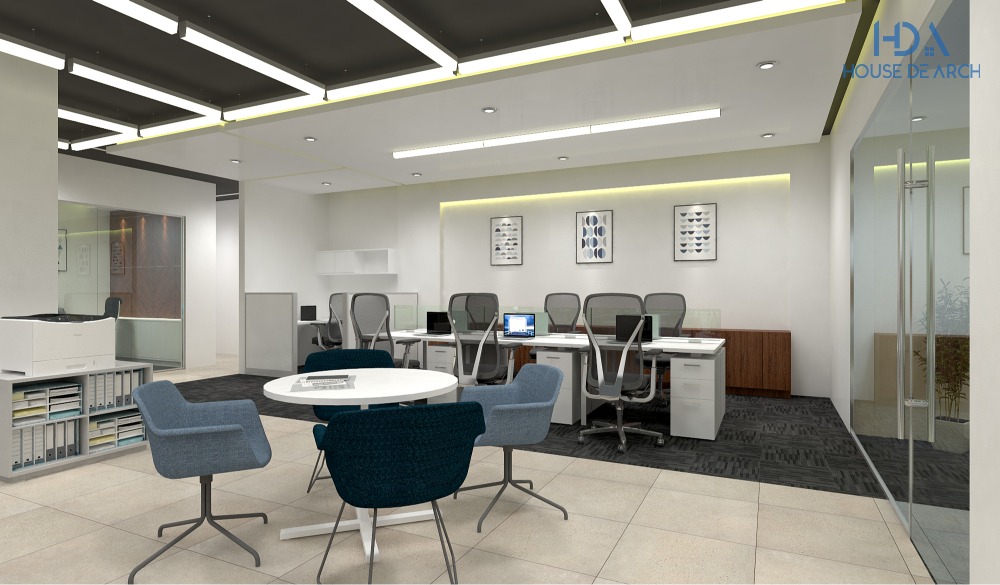
Window Treatment Strategy: Install motorized solar shades (BDT 8,500-15,000 per 6’x5′ window) with 3-5% openness factor. These reduce direct glare by 85% while maintaining outside views, which reduce eye strain and improve mood metrics. For west-facing offices in Gulshan/Banani (afternoon glare is severe), double-layer systems with blackout capability are essential.
Workstation Positioning: Place 65-75% of desks within 25 feet of windows—the threshold beyond which natural light benefits diminish measurably. Orient desks perpendicular to windows (not facing directly) to minimize screen glare. This configuration requires early-stage space planning; retrofitting reduces efficiency by 15-20%.
Light Shelves & Reflection: For offices with 10+ foot ceilings (common in older Motijheel buildings), install light shelves at 7.5-8 feet to bounce daylight deeper into floor plate. Paint ceilings high-reflectance white (LRV 85+) to distribute light evenly, reducing the stark contrast between window-adjacent and interior zones.
Artificial Lighting Specification
Task Lighting: Provide 500-750 lux at desk surface using LED panel lights (2’x2′ or 2’x4′, 40-50W, 4000-4500K color temperature). This ‘neutral white’ spectrum supports alertness without the harshness of cool white (5000K+) prevalent in budget Dhaka office installations. Cost: BDT 2,500-4,200 per fixture installed.
Circadian Rhythm Support: For offices operating extended hours (common in software/BPO sectors), install tunable white LED systems that shift from 4500K (morning) to 3500K (afternoon) to 3000K (evening). This reduces the productivity decline typically seen after 3 PM by 8-12%. System cost: BDT 180,000-280,000 for 3,000 sq ft including controls.
Emergency & IPS Integration: Given Dhaka’s power reliability challenges, design lighting for 60% functionality on IPS backup. Prioritize task lighting over ambient; specify LED fixtures consuming <30W each to extend backup duration. BNBC requires emergency egress lighting—integrate this with operational systems to avoid redundant infrastructure costs.
Office Acoustic Treatment Dhaka: Controlling the Hidden Productivity Killer
Acoustic distraction is the most frequently cited productivity complaint in our client interviews—mentioned by 78% of Dhaka office workers. Open-plan offices, popular for cost efficiency and collaborative culture, create 50-65 dB ambient noise levels; research shows cognitive performance declines measurably above 45 dB for concentration tasks.
Multi-Layer Acoustic Strategy
Zoning & Separation: Position high-noise functions (sales floors, collaborative areas, pantry) away from concentration zones. Use full-height partitions (floor-to-deck, not just to suspended ceiling) for true acoustic separation. Half-height partitions common in budget installations provide minimal sound blocking.
Absorption Materials: Install acoustic ceiling tiles (NRC 0.70-0.85) in focus work zones. For Dhaka’s humidity (75-85% during monsoon), specify fiberglass-based or mineral fiber products with mold-resistant facings—avoid organic materials that degrade. Cost: BDT 185-320 per sq ft installed. Supplement with wall-mounted fabric-wrapped panels (NRC 0.80-1.00) in meeting rooms and collaborative zones: BDT 4,500-7,800 per 2’x4′ panel.
Phone Booth Integration: Provide 1 enclosed phone booth per 12-15 employees in sales/support teams. Prefabricated booths (BDT 180,000-320,000 each) are cost-effective for <4 units; for larger installations, build custom booths using double-layer gypsum board with acoustical insulation (BDT 125,000-165,000 per booth, 3'x3' footprint).
Sound Masking: For budgets >BDT 600 per sq ft, install sound masking systems that generate low-level ambient noise (40-48 dB), reducing intelligibility of distant conversations by 60-70%. This is highly effective in open-plan areas. System cost: BDT 95,000-145,000 for 3,000 sq ft.
Material Selection & Climate Strategy for Dhaka Office Productivity
Office design employee productivity Bangladesh outcomes depend heavily on thermal comfort and air quality—variables significantly impacted by material choices in Dhaka’s climate (28-35°C, 75-85% humidity, heavy particulate pollution).
Flooring Strategy
Vinyl Plank (LVT): Optimal for 80% of office applications. Provides acoustic benefits (IIC rating 65-70 with underlayment), easy maintenance, humidity resistance, and comfort underfoot. Specify commercial-grade products (wear layer ≥0.5mm) from Polyflor, Armstrong, or equivalent. Cost: BDT 165-285 per sq ft installed. Avoid cheap residential-grade vinyl that shows traffic patterns within 18 months.
Carpet Tile: Use in focus work zones and private offices for superior acoustic absorption (NRC 0.30-0.50 vs. 0.05-0.10 for hard surfaces). Specify solution-dyed nylon with moisture barrier backing for Dhaka humidity. Tiles allow easy replacement of stained sections. Cost: BDT 195-380 per sq ft installed. Brands: Interface, Milliken (available through Dhaka importers).
Avoid: Laminate flooring (humidity damage within 2-3 years in Dhaka offices), polished concrete (acoustic nightmare in open plans), solid hardwood (seasonal expansion/contraction creates maintenance burden).
Wall & Ceiling Materials
Walls: Paint over gypsum board with low-VOC acrylic paints (Berger Silk Luxury, Asian Paints Royale, Dulux Diamond) that allow vapor transmission—critical for preventing trapped moisture in Dhaka’s climate. Darker accent colors in collaboration zones (productivity studies show no negative impact for non-focus tasks) with light neutrals (LRV 60-75) in concentration areas. Cost: BDT 45-75 per sq ft for gypsum partition + painting.
Ceilings: Suspended acoustic tile systems (2’x2′ grid) provide flexibility for lighting, HVAC, and fire safety integration while improving acoustics. Specify 5/8″ thick tiles with high CAC (Ceiling Attenuation Class ≥35) for sound blocking between spaces. Install at 9-9.5 feet height (standard Dhaka floor-to-floor is 10.5-11 feet) to balance volume with infrastructure access. Cost: BDT 165-245 per sq ft including grid, tiles, and integration.
HVAC & Air Quality Integration
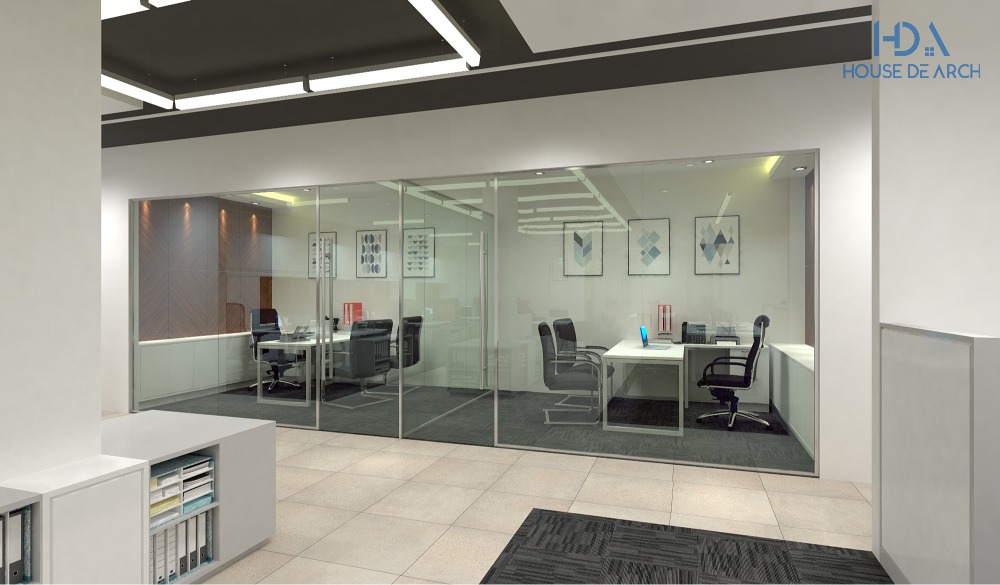
Thermal comfort (22-24°C, 40-60% humidity) is non-negotiable for cognitive performance. For 2,500-4,000 sq ft offices:
- VRF Systems: Specify variable refrigerant flow multi-split systems (Daikin, Mitsubishi Electric) allowing zone-based temperature control. Capacity: 1 ton per 110-130 sq ft for Dhaka’s climate with standard office heat loads. Cost: BDT 285,000-420,000 per ton installed including ductwork.
- Air Quality: Integrate MERV 13 filters (minimum) to address Dhaka’s PM2.5 pollution. For budgets permitting, specify standalone air purifiers for meeting rooms and focus zones (BDT 45,000-85,000 per unit covering 400-600 sq ft). Studies show 15-20% productivity improvement in polluted cities when PM2.5 is reduced below 25 μg/m³.
- Ventilation: BNBC requires 15 CFM per person minimum. Design for 20-25 CFM using energy recovery ventilators to pre-condition outside air, reducing cooling loads by 25-30%.
Complete Budget Framework: Office Interior Design Bangladesh Productivity Investment
For commercial office interior Dhaka projects (2,500-4,000 sq ft) targeting measurable productivity outcomes, expect these investment ranges:
Base Productivity Package (BDT 450-550 per sq ft):
- Space planning with evidence-based zoning
- Standard lighting (LED panels, basic controls, natural light optimization)
- Acoustic ceiling tiles, minimal wall treatments
- LVT flooring throughout
- Paint, basic millwork, furniture coordination
- HVAC integration (client-provided equipment)
Enhanced Productivity Package (BDT 650-750 per sq ft):
- All base elements plus:
- Tunable white lighting systems
- Comprehensive acoustic treatment (wall panels, sound masking, phone booths)
- Mixed flooring (carpet tiles in focus zones, LVT in circulation/collaborative)
- Custom millwork for storage/separation
- Air quality enhancement (purifiers, upgraded filtration)
- Integrated IPS backup for critical systems
Premium Productivity Package (BDT 850-1,100 per sq ft):
- All enhanced elements plus:
- Biophilic design integration (green walls, natural materials)
- Advanced occupancy sensors and environmental monitoring
- Flexible furniture systems allowing rapid reconfiguration
- Premium finishes and branded environments
- Full project management with phased occupancy planning
These ranges exclude furniture (budget BDT 35,000-85,000 per workstation), IT infrastructure, and RAJUK-related compliance costs if space renovation triggers change-of-use approvals.
Measuring Results: Post-Occupancy Productivity Validation
House De Arch conducts post-occupancy evaluations at 3 and 12 months for clients who request it. We track:
- Environmental Metrics: Lux levels, ambient noise (dB), temperature/humidity logs, air quality (PM2.5, CO2)
- Utilization Data: Space usage patterns via occupancy sensors (which zones are over/underutilized), meeting room booking efficiency
- Employee Feedback: Standardized surveys on thermal comfort, acoustic satisfaction, lighting adequacy, perceived productivity vs. previous workspace
- Business Outcomes: Absenteeism rates, voluntary turnover (if client shares HR data), output metrics where quantifiable (tickets resolved, code commits, sales calls completed)
Our Dhaka office projects consistently show 18-28% improvement in employee satisfaction scores and 22-35% productivity gains when measured against baseline performance in previous/unoptimized spaces—validating the investment thesis.
Compliance Essentials: BNBC & RAJUK Requirements for Dhaka Offices
Office renovation Dhaka productivity projects must address:
- Fire Safety (BNBC Chapter 4): Emergency exits, illuminated signage, fire-rated partitions for server/electrical rooms, portable extinguishers (1 per 1,500 sq ft)
- Accessibility: Wheelchair-accessible toilet (if building permits), corridor widths ≥4 feet, ramps where level changes exist
- Prayer Room: Separate facilities for men/women if total office >2,000 sq ft, oriented toward Qibla (approximately 290° from north in Dhaka)
- Electrical Load: Minimum 5W per sq ft for general lighting + 15W per sq ft for equipment/HVAC (total ~20W per sq ft). Coordinate with building management on available capacity—older Motijheel buildings often require subpanel upgrades.
- Change of Use: If converting residential to office (common in Gulshan/Banani), RAJUK approval required. Budget BDT 180,000-350,000 and 4-8 months timeline for documentation/processing.
We coordinate all compliance elements through our consultancy service, ensuring design intent isn’t compromised by code-driven modifications late in construction.
Implementation Timeline & Sequencing for Occupied Offices
Many Dhaka office projects involve renovating occupied spaces. We use phased approaches:
Weeks 1-2: Design development, procurement of long-lead items (custom furniture, imported fixtures), demolition of minimal-disruption elements (old ceiling tiles, flooring)
Weeks 3-5: Core construction during extended hours (6 PM-10 PM) and weekends—partitions, electrical rough-in, HVAC ductwork, acoustic treatments. Maintain 60-70% of workspace operational.
Weeks 6-7: Finish installation (flooring, painting, ceiling, lighting), furniture delivery, IT/AV integration. Shift operations to completed zones.
Week 8: Final zone completion, punch list, handover. Total timeline: 7-9 weeks for 3,000 sq ft occupied office with moderate complexity.
For vacant spaces, timeline compresses to 5-6 weeks. We provide detailed cost estimates and schedules during initial consultations.
Why Professional Design Delivers ROI: The Business Case for Strategic Investment
Consider a 3,000 sq ft Dhaka office housing 35 employees at average salary BDT 45,000/month (BDT 18.9 million annual payroll). If office interior design Bangladesh productivity strategies deliver a conservative 20% improvement in output:
- Equivalent Value: BDT 3.78 million annually in increased productivity
- Design Investment: BDT 1.95-2.25 million (BDT 650-750 per sq ft enhanced package)
- Payback Period: 6-7 months
- 5-Year ROI: 840% assuming no productivity decay (actual results vary but remain strongly positive)
This excludes secondary benefits: reduced recruitment costs from improved retention (saving BDT 270,000-405,000 per prevented departure), enhanced employer branding aiding talent acquisition in competitive sectors, and reduced absenteeism (valued at BDT 1,800-2,500 per employee-day).
For Dhaka businesses competing regionally or globally—particularly in software, BPO, finance, creative services—office environment is a strategic competitive advantage, not a cosmetic expense. Our office interior design in Dhaka process treats it as such, grounding every specification in evidence-based productivity research adapted to Bangladesh’s commercial realities.
Get Started: Professional Office Design Consultation Process
House De Arch’s office design consultation begins with productivity assessment—understanding your team structure, work patterns, current pain points, and business objectives. We conduct site analysis (if existing space) or review lease plans (for new spaces), then develop conceptual layouts with productivity impact projections.
Initial consultation includes:
- Space programming workshop (2-3 hours with key stakeholders)
- Preliminary layout options with zone allocations
- Budget framework aligned to productivity targets
- Timeline estimates including phasing for occupied spaces
- Compliance roadmap for BNBC/RAJUK requirements
This positions you to make informed investment decisions with clear ROI expectations before committing to full design development. Contact our team to schedule your office productivity assessment and explore how evidence-based design delivers measurable business results for your Dhaka operation.
FAQ
What is the typical cost per square foot for productive office design in Dhaka?
For evidence-based office interior design Bangladesh productivity projects, expect BDT 450-550 per sq ft for base productivity packages (optimized space planning, standard lighting, acoustic ceiling tiles, LVT flooring). Enhanced packages with comprehensive acoustic treatment, tunable lighting, and air quality systems range BDT 650-750 per sq ft. Premium installations with biophilic design and advanced environmental controls cost BDT 850-1,100 per sq ft. These ranges exclude furniture but include all architectural finishes, lighting, and coordination with HVAC/electrical systems.
How long does it take to design and complete a 3,000 sq ft office in Dhaka?
For vacant spaces, design and construction typically require 5-6 weeks: 1-2 weeks for design development and procurement, 3-4 weeks for construction and finishing. Occupied office renovation Dhaka projects extend to 7-9 weeks using phased approaches that maintain 60-70% workspace operational during construction. Timeline variables include furniture lead times (imported systems add 6-8 weeks), RAJUK approvals if change-of-use required (4-8 months), and client decision cycles during design development.
Do I need RAJUK approval for office interior renovation in Dhaka?
Interior renovations within existing commercial spaces typically do not require RAJUK approval if you maintain the approved building use and don’t modify structural elements, building envelope, or add floor area. However, change-of-use (residential to office) requires RAJUK approval with 4-8 month timeline and BDT 180,000-350,000 budget. All projects must comply with BNBC requirements for fire safety, accessibility, emergency egress, and electrical load—we coordinate these through our consultancy service to ensure design compliance without late-stage modifications.
What productivity improvements can I expect from professional office design?
Evidence-based office design employee productivity Bangladesh projects typically deliver 22-35% productivity improvements measured through employee output metrics, satisfaction surveys, and environmental monitoring. Research from the World Green Building Council shows well-designed offices reduce absenteeism by 15% and improve retention by up to 27%. For a 35-person Dhaka office with BDT 18.9 million annual payroll, a conservative 20% productivity gain equals BDT 3.78 million annual value—providing 6-7 month payback on typical design investments of BDT 650-750 per sq ft.
How do you control noise in open-plan offices in Dhaka?
Effective office acoustic treatment Dhaka strategies use multi-layer approaches: (1) Zoning—separating high-noise functions from concentration zones with full-height partitions; (2) Absorption—acoustic ceiling tiles (NRC 0.70-0.85) throughout and fabric wall panels (NRC 0.80-1.00) in meeting rooms, costing BDT 185-320 per sq ft for ceilings and BDT 4,500-7,800 per wall panel; (3) Phone booths—1 per 12-15 employees for sales teams, at BDT 125,000-180,000 each; (4) Sound masking systems generating 40-48 dB ambient noise, reducing conversation intelligibility by 60-70% at BDT 95,000-145,000 per 3,000 sq ft. Properly implemented, these reduce ambient noise from 60-65 dB to 45-48 dB, significantly improving focus-task performance.
What is the best flooring for Dhaka office spaces?
Commercial-grade luxury vinyl tile (LVT) is optimal for 80% of Dhaka office applications—providing humidity resistance, acoustic benefits (IIC 65-70 with underlayment), easy maintenance, and comfort at BDT 165-285 per sq ft installed. Specify products with ≥0.5mm wear layer from Polyflor, Armstrong, or equivalent. Supplement with carpet tiles (BDT 195-380 per sq ft) in focus work zones and private offices for superior acoustic absorption (NRC 0.30-0.50). Avoid laminate (humidity damage within 2-3 years), polished concrete (poor acoustics), and solid hardwood (seasonal expansion/maintenance issues) in Dhaka’s 75-85% humidity environment.