Interior design in Bangladesh is evolving at a pace that would have seemed extraordinary a decade ago. A generation of globally connected, design-literate clients — building new homes in Bashundhara, fitting out offices in Gulshan, opening restaurants in Dhanmondi — are raising the standard of every space category simultaneously. This guide draws directly on what House De Arch is seeing in 2025: the briefs clients are bringing, the spaces we are building, and the interior design trends genuinely shaping Bangladesh this year.
1. Japandi: Still the Most Requested Residential Aesthetic
Japandi — the design philosophy that fuses Japanese minimalism with Scandinavian warmth — remains the single most requested aesthetic in Bangladesh’s premium residential market. What makes it distinctive is not a specific look but a governing attitude: every object in a home should earn its place through function or genuine beauty; materials should be natural and honest; and space itself should be given the same consideration as the objects within it.
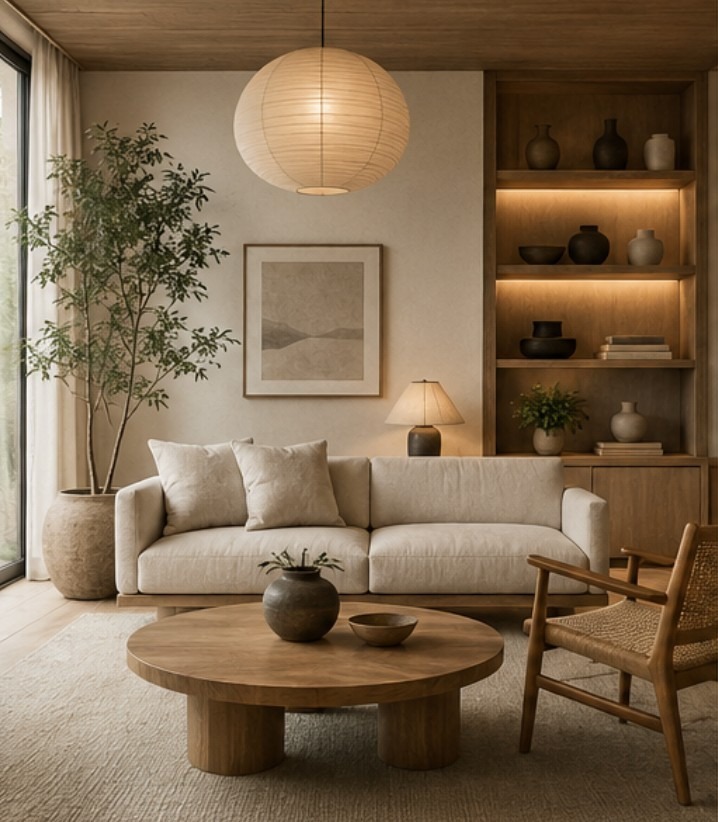
In practice, a Japandi interior in Dhaka means warm plaster walls in cream or greige, a solid timber round coffee table as the living room’s centrepiece, a cream or oatmeal linen sofa with understated cushions, a large paper globe pendant casting warm diffuse light, built-in timber shelving displaying carefully chosen ceramics and a handful of books, a large-scale indoor plant bringing living texture, and a rattan accent chair that introduces natural material without weight. The timber ceiling detail — visible in the most refined versions — completes the warmth of the material language overhead.
This is not a style that follows trends. It is a style that replaces them — a commitment to calm, quality, and material honesty that ages well precisely because it was never chasing novelty in the first place. Clients who choose Japandi in 2025 are making a 10-year decision, not a 3-year one.
2. Biophilic Design: From Trend to Necessity
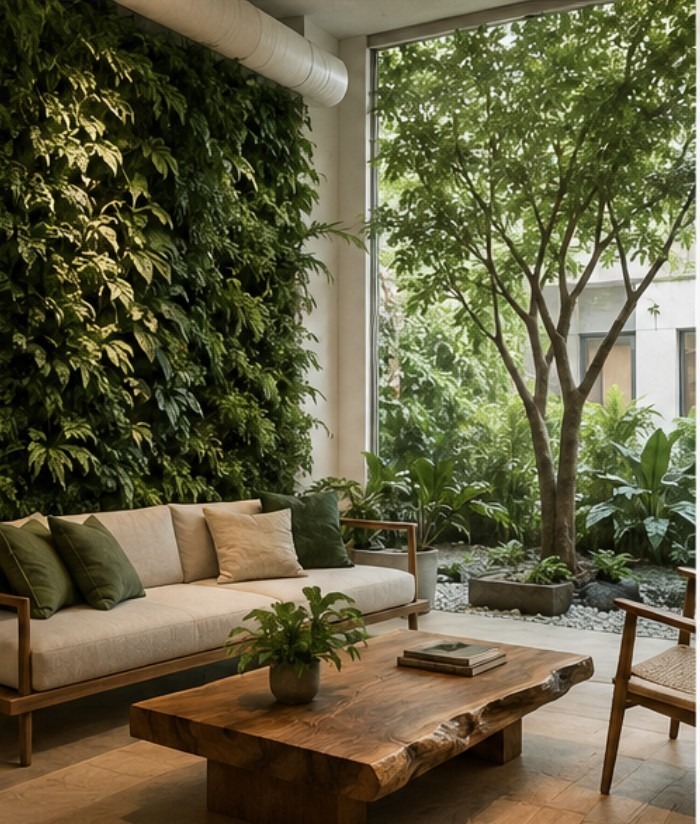
Biophilic design — the intentional integration of natural elements, materials, and systems into built environments — has crossed from trend into mainstream expectation in Bangladesh’s premium market. Clients who would not have mentioned plants or greenery in a design brief three years ago are now specifying living walls, floor-to-ceiling glazing with garden views, live-edge timber surfaces, and indoor trees as non-negotiable elements of their projects.
The science behind this shift is clear. Access to natural elements — particularly greenery, natural light, and views of vegetation — reduces cortisol levels, improves concentration, increases productivity, and elevates mood. In Dhaka, where green space is scarce and urban density is intense, the biophilic interior provides a genuine restorative environment that residents and workers actively seek out. The space itself becomes a refuge.
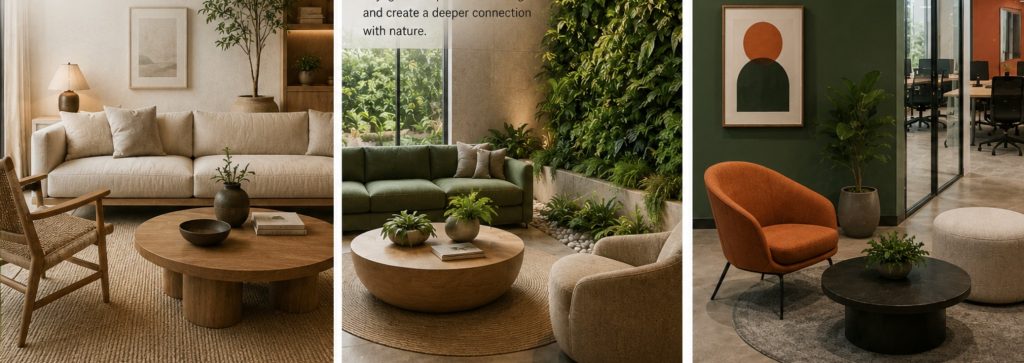
The most powerful biophilic statement available in interior design is the full-height living plant wall — a vertical garden of tropical species covering an entire wall plane, floor to ceiling. Bangladesh’s warm, humid climate is ideal for this application: plants thrive with minimal maintenance, achieving in months the dense, layered appearance that would take years in a cooler, drier environment. Paired with a live-edge slab timber coffee table — a single piece of timber with its natural edge retained, each one unique — and a linen sofa with olive green cushions that echo the planting, the biophilic interior becomes a fully coherent design language rather than a collection of separate plant decisions.
The transparency of the space matters as much as the planting. Full-height glazing that connects the interior to a garden, courtyard, or planting bed beyond extends the biophilic effect beyond the building envelope — the view of a mature tree through floor-to-ceiling glass is as powerful as any planted wall.
3. Bold Colour in Commercial Spaces: The End of Corporate Beige
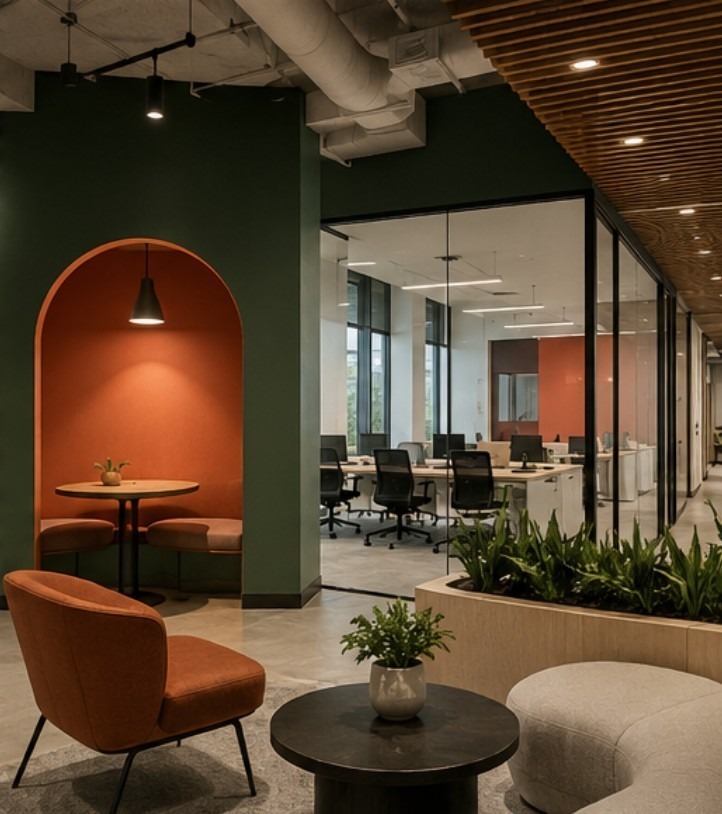
Nothing signals a maturing design culture more clearly than confidence with colour — and Bangladesh’s commercial interior market is developing that confidence rapidly. The generic beige-and-grey corporate palette that has dominated Dhaka offices for a decade is being deliberately replaced by spaces with strong, considered colour identities. Forest green, terracotta, burnt orange, and deep teal are appearing on feature walls, column treatments, and as the dominant palette of entire office zones.
The most sophisticated examples combine two bold colours in deliberate tension: a deep forest green on structural columns and primary walls creates a grounded, nature-connected backdrop; a terracotta arch nook — its warm orange interior lit by a pendant, furnished with a small bistro table and curved bench seating — provides a contrasting warm accent that creates a destination within the floor plate. An orange velvet armchair, a dark round coffee table, and carefully positioned indoor plants complete the foreground composition.
This approach does something that neutral corporate interiors cannot: it creates memorable, navigable spaces. The terracotta nook is a destination — people gravitate to it, use it, associate it with the brand. The green corridor with glass partitions into a well-lit open-plan workspace communicates simultaneously that this company is serious about its work and confident about its identity. The timber slatted ceiling overhead adds warmth and natural texture to an otherwise hard-surfaced environment.
Companies making these colour investments are doing so for concrete business reasons: attracting talent who benchmark against global workplace standards; creating spaces that communicate brand values to clients and visitors; and building environments where employees genuinely want to be. The ROI on bold colour in commercial interiors is measurable and increasingly well-documented.
4. Warm Minimalism: Calm Over Clinical
Pure minimalism — stark white walls, empty surfaces, zero decoration — is being replaced across Bangladesh’s residential and hospitality markets by warm minimalism: the same commitment to clean lines and considered space, but executed in warm colours, natural textures, and layered lighting that creates comfort rather than austerity. The goal is a home that feels edited and intentional, not empty and cold.
The distinction is important. Warm minimalism is not the absence of things — it is the presence of the right things. A single large-scale indoor tree in a terracotta pot. A round timber coffee table with a natural ceramic bowl and a single book on its surface. A linen throw folded precisely over one arm of the sofa. A table lamp casting a warm pool of light in the corner. Each element is chosen; nothing is accidental. The warmth comes from the material choices (timber, linen, ceramics, natural fibres) and the lighting (layered, warm, dimmed in the evening), not from the number of objects.
This aesthetic is particularly well-suited to Dhaka’s premium apartment market, where floor plates are typically compact and the discipline of editing is a practical as well as aesthetic virtue. A warm minimalist apartment feels spacious because every element has breathing room; it feels designed because every decision is visible.
5. Natural Materials: Timber, Stone, Linen and Rattan
Across every project category — residential, commercial, hospitality, retail — the most consistent material direction in 2025 Bangladesh is towards the natural and the honest. Clients are specifying solid timber over veneer where budget allows, natural stone over porcelain where practicality permits, linen and organic cotton over synthetic fabrics wherever possible, and rattan, cane, and bamboo as accent materials that introduce lightness and craft.
This is not nostalgia — it is a response to the accumulated experience of a decade of synthetic materials that looked good in photographs and aged poorly in Bangladesh’s humid, tropical climate. Natural materials, by contrast, age with character. Solid timber develops patina. Natural stone acquires the story of use. Rattan and linen weather to a softened version of their original selves rather than peeling, cracking, or discolouring. For clients making design investments intended to last a decade, natural materials are simply a better choice.
The live-edge slab coffee table — a single piece of timber with its natural edge retained — has become one of the most requested individual furniture pieces in premium Bangladeshi residential briefs. It functions as a design statement (no two are identical), a material commitment (solid timber, not veneered composite), and a biophilic element (bringing the form and texture of natural growth into the interior) simultaneously.
6. Arched Forms and Curved Architecture
The arch is everywhere in 2025 interior design — and for good reason. Arched doorways, curved wall niches, and arch-shaped alcoves introduce a warmth and generosity of form that rectangular openings cannot provide. They slow the eye, create destinations within a floor plate, and reference a formal vocabulary shared by Mughal architecture, colonial-era buildings, and Mediterranean design — all traditions with resonance in Bangladesh’s cultural landscape.
The commercial application of this trend is particularly compelling: a terracotta arched alcove within an otherwise rectilinear office creates a focal point that draws people in, provides an informal meeting or focus space, and introduces a human-scale intimacy that large open-plan floors often lack. The arch is simultaneously practical (it creates a defined zone without a door or wall) and emotional (it signals welcome, enclosure, and shelter in a way that a right-angled corner never does).
7. Sustainable Specification: No Longer Optional
Sustainability in interior design has shifted from a preference to a requirement in Bangladesh’s premium market over the past two years. Clients who would previously have accepted any specification now ask about material origins, manufacturing processes, VOC content, energy efficiency, and end-of-life recyclability. This is particularly true of corporate clients with ESG commitments and younger residential clients who have grown up with environmental awareness as a baseline value.
The practical case for sustainable specification in Bangladesh is strong and simple: locally sourced materials cost less to transport and support local craft industries; natural materials typically outperform synthetics in tropical conditions; LED lighting reduces energy bills significantly over the building’s lifetime; and designs that maximise natural ventilation and daylight reduce air conditioning load, which in Bangladesh’s climate is one of the largest operating costs a building carries.
8. Hybrid-Ready Spaces: Designing for How We Actually Work
The permanent shift to hybrid working has changed what both homes and offices need to do. Home offices are being designed into apartments that previously had no dedicated workspace — not as spare rooms repurposed with a desk, but as properly designed environments with appropriate lighting, acoustic treatment, and ergonomic furniture. Offices are being redesigned around the reality that people come in to collaborate and connect, not to sit at an assigned desk all day.
The most successful hybrid office designs in Dhaka in 2025 combine generous open-plan collaboration zones (glass-walled for visual connection, acoustically managed for comfort), a variety of informal work settings (the arched nook, the café-height counter, the lounge corner), and well-equipped meeting rooms — all within a coherent colour and material language that makes the whole floor plate feel like a single, considered environment rather than a collection of separate spaces.
9. Artisan Craft and Handmade Elements
Bangladesh has an extraordinary tradition of craft — Nakshi Kantha textiles, hand-thrown ceramics, woven baskets and mats, hand-block-printed fabrics — and a growing number of designers and clients are integrating these traditions into contemporary interiors with genuine skill and intention. This is not ethnic decoration applied to generic spaces; it is the use of genuinely local craft objects as primary design elements, given the prominence their quality deserves.
A hand-thrown ceramic vessel on a timber shelf. A Nakshi Kantha panel framed as artwork. A woven jute rug as the anchor of a living room. These elements give spaces a depth and authenticity that imported generic objects cannot achieve — and they tell a story about where the design comes from that resonates with international visitors and locally proud clients in equal measure.
10. Lighting Design as a Primary Design Decision
The role of lighting in defining the quality of an interior is becoming better understood in Bangladesh’s design market — and client briefs are reflecting this understanding. Lighting is no longer an afterthought resolved by the electrician after the designer has finished; it is a primary design input that shapes the character of every room, every hour of the day.
The paper globe pendant — visible in the Japandi interior above — does not merely provide light; it defines the scale of the room, establishes the seating area beneath it as a social zone, and creates a warm, diffuse quality of illumination that makes every person and every material within its reach look their best. The timber table lamp in the corner creates a pool of warmth that no ceiling fitting can replicate. The concealed LED strip within a shelf unit provides gentle ambient fill without any visible source. These are layered lighting decisions — each one simple in itself, transformative in combination.
Which Trends Should You Apply to Your Project?
Not every trend suits every project, client, or budget. The skill in applying trends is in understanding which ones align with the specific brief — and which to ignore. Japandi works for a client who values calm and natural materials; it will frustrate a client who finds it cold or empty. Bold colour works for a brand with the confidence to commit; it will feel wrong for a company whose culture is conservative and whose clients expect formality.
At House De Arch, we begin every project by understanding the client’s values, lifestyle, and long-term goals before discussing what is currently trending. We apply what is genuinely relevant, adapt what can be adapted, and confidently discard what would serve only the trend rather than the brief. The result is interiors that feel current without being dated — designed to remain right well beyond the year they were created.
Frequently Asked Questions
What is the most popular interior design trend in Bangladesh in 2025?
Japandi — the fusion of Japanese minimalism and Scandinavian warmth — is consistently the most requested aesthetic in premium residential briefs across Dhaka. In commercial spaces, bold colour combined with biophilic elements is the dominant direction, particularly in offices serving technology, creative, and professional services companies.
Do global interior design trends apply to Bangladesh’s climate and culture?
Yes, with thoughtful adaptation. Biophilic design performs particularly well in Bangladesh’s warm, humid climate — plants thrive and living walls develop rapidly. Natural materials (timber, stone, rattan) generally outperform synthetics in tropical conditions. Bold colours suit the luminous tropical light. The key is filtering global trends through local knowledge: how materials perform in high humidity, how light behaves in Dhaka apartments, and what resonates with Bangladeshi cultural values.
How much does it cost to incorporate these trends in a Dhaka home?
Costs vary enormously by specification level. A Japandi-influenced living room can be achieved from ৳3L–৳5L at mid-range quality (solid timber coffee table, quality linen sofa, globe pendant, ceramics). A premium biophilic fit-out with a full living wall, live-edge furniture, and floor-to-ceiling glazing will cost significantly more. See our interior design cost guide for detailed project-type budgets.
How long do these trends last before they need to be updated?
The foundational trends covered here — biophilic design, natural materials, warm minimalism, Japandi — reflect deep shifts in values rather than surface fashion cycles. They will remain relevant for 8–12 years. More surface-level choices — specific colour combinations, particular furniture forms — typically run 3–5 year cycles. The design strategy: invest in timeless foundational decisions; apply trend-sensitive choices in easily updated elements like soft furnishings, accessories, and paint.
Related: Residential Interior Design in Dhaka | Office Interior Design Bangladesh | Modern Office Design Trends 2025 | Restaurant Design Trends 2025 | Interior Design Cost Guide
Ready to bring the right 2025 trends into your space? Contact House De Arch — we design homes and offices that are current today and timeless tomorrow.