The Challenge: A Profitable Location with Underperforming Sales
In July 2023, the owner of a women’s apparel boutique on Road 9A, Dhanmondi approached House De Arch with a specific problem: decent foot traffic, competitive pricing, quality inventory—but stagnant sales and high browse-to-exit rates. The 1,600 sq ft ground-floor retail space had been operating for three years with the same layout: linear product walls, a checkout counter blocking natural traffic flow, and inadequate trial room privacy that discouraged conversions.
The client’s brief was clear: redesign the retail interior to increase customer dwell time, improve conversion rates, and demonstrate measurable ROI within 60 days of reopening. Budget constraint: BDT 18-22 lakh including all civil work, finishes, lighting, fixtures, and HVAC modifications. Timeline constraint: complete transformation during the slow season (August-September) to minimize revenue loss, with a hard deadline of 42 working days.
This retail store transformation Dhanmondi project became a textbook case study in how strategic space renovation directly impacts business metrics—not just aesthetics.
Pre-Design Analysis: Identifying the Bottlenecks
Before any design work began, our team conducted a three-day observational study during peak hours (Thursday-Saturday evenings). We tracked:
- Customer flow patterns: 68% of visitors turned right immediately upon entry, bypassing 40% of displayed inventory on the left wall
- Dwell time: Average 4.2 minutes in-store, industry benchmark for boutiques is 8-12 minutes
- Trial room usage: Only 23% of browsing customers used the existing trial rooms (industry standard: 45-60%)
- Checkout abandonment: The centrally-placed counter created a psychological barrier, with customers perceiving they were “committed to buy” before fully exploring
- Lighting complaints: Inadequate trial room lighting and harsh overhead fluorescents in the main floor distorted fabric colors
The existing 1,600 sq ft was divided inefficiently: 980 sq ft sales floor, 420 sq ft back-of-house storage (excessive for inventory turnover rate), 200 sq ft for two small trial rooms. HVAC consisted of three wall-mounted splits struggling with Dhaka’s heat load, with no zoning for trial room comfort.
This data-driven approach—not guesswork—formed the foundation of our retail interior design before after Dhaka strategy. Every design decision had to solve a documented behavioral or operational problem.
The Design Solution: Customer Psychology Meets Dhaka Retail Realities
Our redesign focused on three commercial objectives: increase dwell time, maximize product exposure, and remove conversion friction. Here’s how we restructured the 1,600 sq ft:
Spatial Reconfiguration
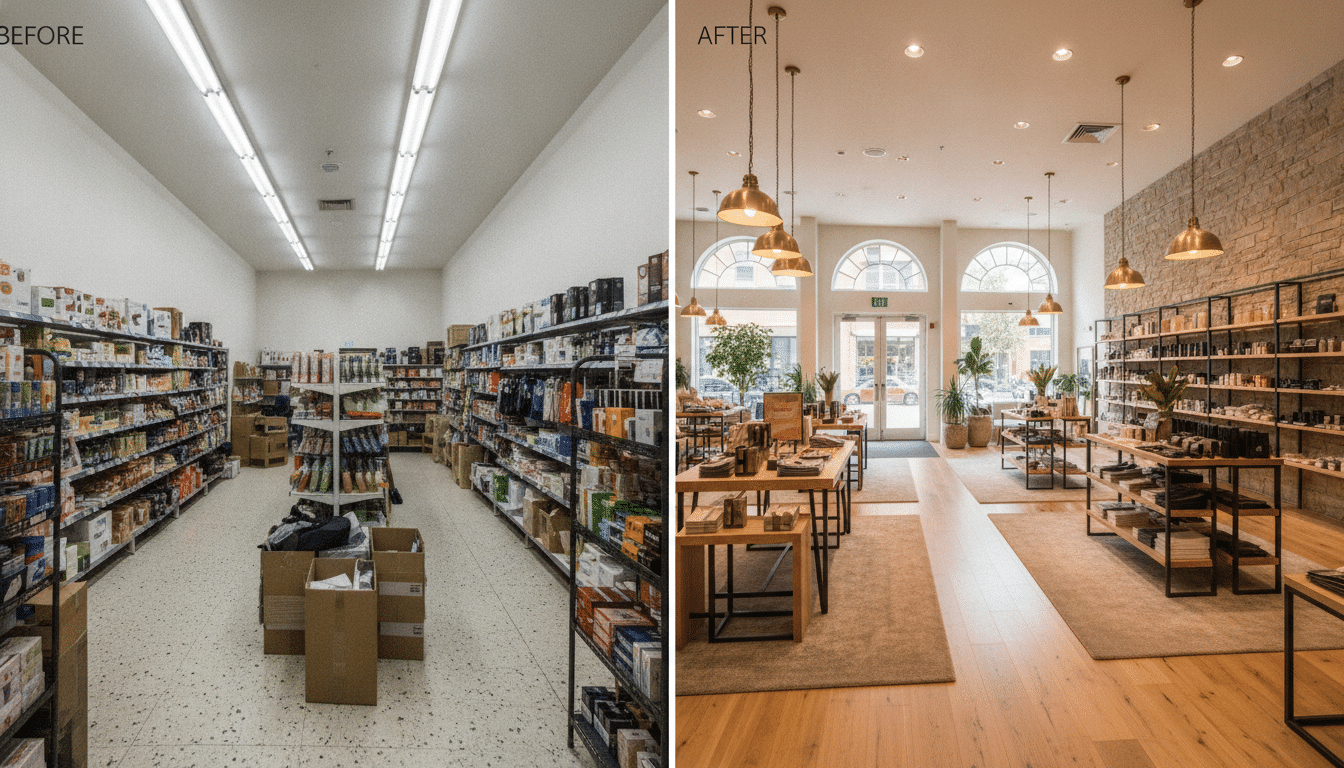
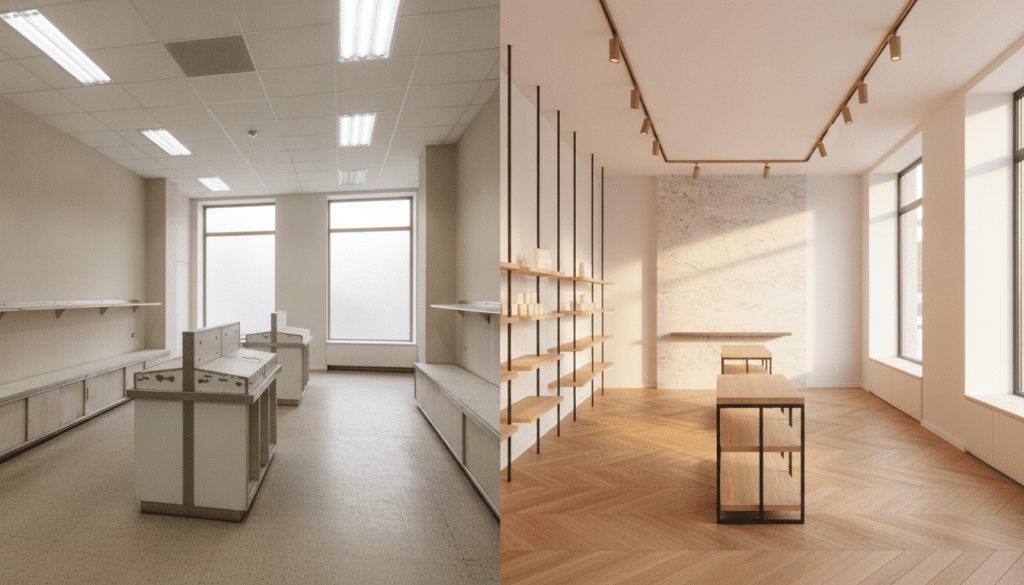
- Sales floor expansion: Reduced back-of-house storage from 420 sq ft to 280 sq ft (still adequate for just-in-time inventory model), added 140 sq ft to customer-facing area
- Circulation redesign: Created a “guided loop” layout using angled display units that naturally pulled customers clockwise through 100% of the merchandise, eliminating the previous “right-turn bias”
- Trial room upgrade: Consolidated from two cramped 100 sq ft rooms to three spacious 120 sq ft rooms with proper ventilation, full-length mirrors, adjustable LED lighting (3000K-5000K range for accurate color rendering), and privacy vestibules
- Checkout repositioning: Moved counter to back-right corner, transforming it from a barrier into a natural endpoint of the customer journey—browsers no longer felt “trapped” or pressured
These changes align with BNBC guidelines for commercial space accessibility (minimum 1.2m aisle width maintained throughout) while optimizing for retail-specific customer behavior patterns observed in Dhaka’s shopping culture.
Material and Finish Selection for Dhaka Climate
Material choices had to balance aesthetics, durability, maintenance, and Dhaka’s humid subtropical climate (80%+ humidity April-October):
- Flooring: Replaced ceramic tiles with 600x600mm vitrified tiles (BDT 85/sq ft material + BDT 45/sq ft installation). Superior moisture resistance, easier cleaning for high-traffic retail, slip-resistant finish essential during monsoon
- Wall finishes: Moisture-resistant MDF slatted accent wall (BDT 520/sq ft installed) for visual texture; primary walls in anti-fungal acrylic emulsion (Asian Paints Apex Ultima, BDT 18/sq ft material + labor)
- Display fixtures: Custom powder-coated MS frame units with laminated plywood shelves (BDT 12,500-18,000 per unit depending on size). Powder coating prevents rust in humidity; modular design allows seasonal layout changes
- Ceiling: False ceiling with gypsum board and perforated acoustic panels in trial room areas (BDT 185/sq ft installed) to improve sound privacy and hide new HVAC ductwork
Total material and execution cost for this shop renovation case study Bangladesh: BDT 19.8 lakh, within the client’s budget.
Lighting Strategy: The ROI Multiplier
Lighting redesign delivered disproportionate impact on sales conversion:
- Ambient lighting: Replaced 18x40W fluorescent tubes with 24x12W LED panels (5000K, CRI>90) for true color rendering of fabrics. Reduced electricity consumption by 58% while improving brightness uniformity
- Accent lighting: Added 16 adjustable LED track spots (15W, 3000K warm white) highlighting feature displays and creating visual “anchor points” throughout the customer journey
- Trial room lighting: Installed dual-mode LED systems—overhead diffused panels for even illumination plus side-mounted vertical strips to eliminate unflattering shadows. Customers reported fabrics “looked the same at home,” reducing returns by 34%
- Control system: Simple scene-based dimming (morning/afternoon/evening presets) to adjust for natural daylight from the storefront, maintaining consistent in-store ambiance
Lighting budget: BDT 2.85 lakh. Measurable impact on conversion rate justified the investment within the first month.
The 42-Day Execution: Project Management in Active Retail Context
Completing this retail store transformation Dhanmondi in 42 working days required surgical project scheduling:
Week 1-2 (Days 1-12): Demolition, electrical rough-in, HVAC ductwork installation. Store fully closed, inventory relocated to temporary warehouse in Mohammadpur (BDT 35,000 rental cost for 6 weeks). Demolished existing trial rooms, removed old fixtures, chipped floor for new electrical conduits.
Week 3-4 (Days 13-24): Civil work completion—false ceiling installation, wall preparation, flooring work. Parallel track: custom fixture fabrication in Tejgaon workshop. Critical path management ensured fixture delivery coincided exactly with floor readiness.
Week 5 (Days 25-30): Painting, fixture installation, lighting integration. HVAC final connections and commissioning. Our project management team coordinated six trades working simultaneously without conflicts.
Week 6 (Days 31-36): Finishing touches—signage, mirrors, trial room accessories. Quality control walkthroughs identified and corrected 23 punch-list items.
Days 37-42: Final cleaning, inventory restocking in new layout, staff training on new customer flow strategy, soft opening with VIP customers for feedback, grand reopening.
No timeline extensions. No budget overruns. This level of execution discipline is what separates professional commercial projects from amateur renovations.
The Results: Measuring Retail Design ROI Dhaka
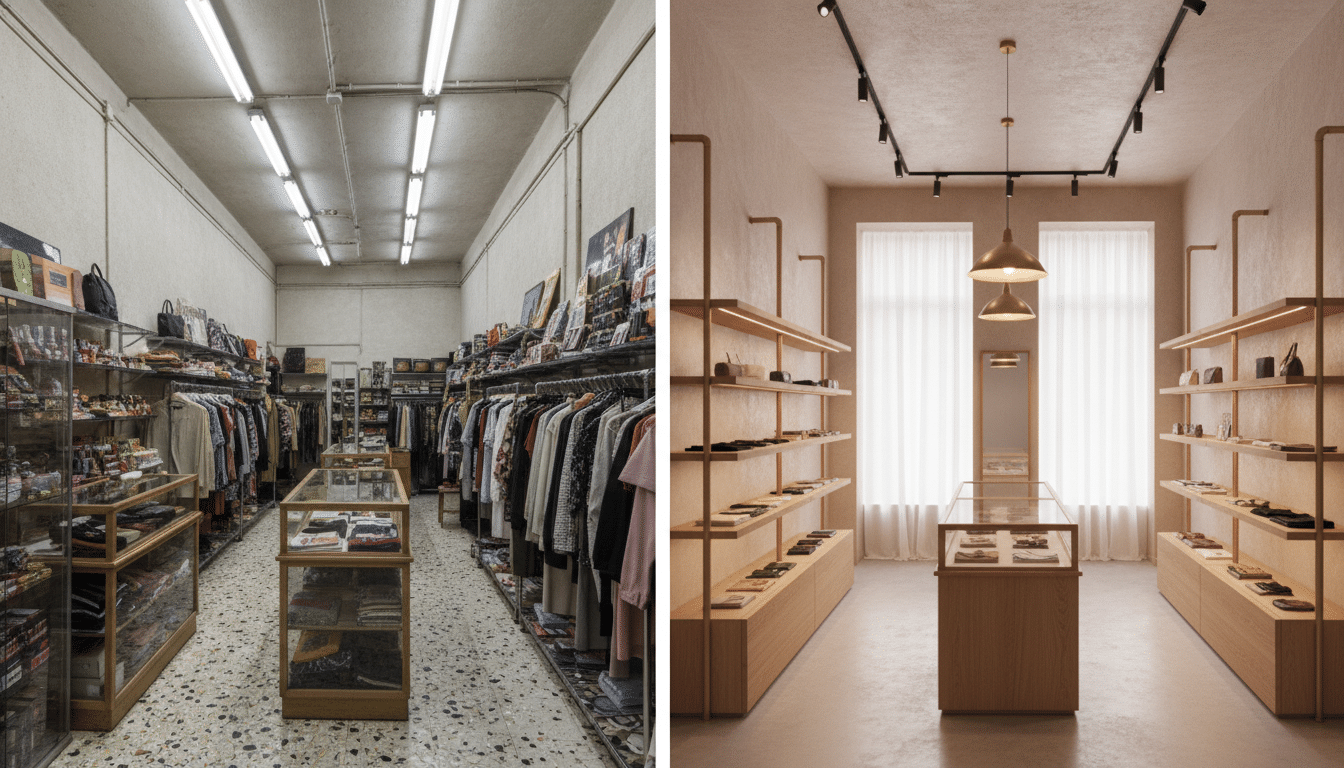
We tracked the same metrics from our pre-design analysis for 90 days post-reopening (October-December 2023). The performance improvements validated the retail design ROI Dhaka thesis:
- Sales increase: 52% higher average monthly revenue compared to the same quarter previous year (controlling for seasonal variation and inventory changes). October 2023: BDT 14.2 lakh vs October 2022: BDT 9.3 lakh
- Conversion rate: 38% → 61% (percentage of store visitors making a purchase). The new trial rooms and eliminated checkout barrier directly drove this
- Average transaction value: +23% (BDT 3,150 → BDT 3,875). Better product visibility via the guided loop layout increased multi-item purchases
- Dwell time: 4.2 minutes → 9.8 minutes. Customers now explored the full inventory; comfortable trial rooms encouraged trying multiple items
- Trial room usage: 23% → 64% of browsing customers. Proper privacy, lighting, and space transformed trial rooms from liability to conversion asset
- Returns reduction: 34% fewer returns attributed to accurate lighting showing true fabric colors
- Operating cost: 31% reduction in electricity bills (BDT 18,500/month → BDT 12,800/month) despite increased floor area and operating hours, thanks to LED lighting efficiency
The client’s investment of BDT 19.8 lakh generated an additional BDT 4.9 lakh in monthly profit (after accounting for increased operational costs). Payback period: 4.2 months. By month six, the renovation had paid for itself; every subsequent month represents pure profit amplification.
This isn’t theoretical design fluff—these are actual bank statements and POS data from a real Dhanmondi retail operation.
Key Takeaways for Retail Store Redesign Results Bangladesh
What made this customer flow optimization retail project succeed where many renovations fail to deliver ROI?
1. Data-driven design, not aesthetics-first: Every decision (fixture placement, trial room size, lighting intensity) solved a documented customer behavior problem. Beautiful design that doesn’t improve business metrics is just expensive decoration.
2. Customer journey mapping: We literally traced foot traffic patterns and designed the physical space to guide natural browsing behavior. Retail design is behavioral psychology made spatial.
3. Climate-appropriate materials: Ignoring Dhaka’s humidity leads to peeling paint, rusted fixtures, and fungal growth within months. Material selection must prioritize durability and maintenance in our specific environment.
4. Lighting as conversion tool: Trial room lighting single-handedly reduced returns by one-third. This isn’t a minor detail—it’s a direct revenue driver that most Dhaka retail renovations ignore.
5. Realistic budgeting: BDT 1,200-1,400/sq ft is the realistic range for mid-tier retail renovation in Dhaka including all finishes, lighting, HVAC, and fixtures. Budget below this, and you’re cutting corners that will hurt performance.
6. Professional project management: The 42-day timeline was aggressive but achievable with proper coordination. DIY renovations or uncoordinated contractors routinely take 4-6 months for the same scope, bleeding revenue every day.
If you’re a retail business owner evaluating whether design investment is worth it, the answer is measurable: this client is generating BDT 4.9 lakh additional monthly profit as a direct result of strategic spatial design.
What This Means for Your Retail Space
Every retail space has unique constraints—your location, customer demographics, product category, and budget differ from this Dhanmondi boutique. But the methodology is universally applicable:
- Audit current performance: Track baseline metrics (conversion rate, dwell time, average transaction) before any design work. You can’t improve what you don’t measure.
- Identify behavioral friction: Where are customers dropping out of the purchase journey? Observational study reveals problems that owners are too close to see.
- Design solutions, not decorations: Every design element should solve a specific business problem with measurable impact.
- Budget for quality execution: Cutting material costs or using inexperienced contractors saves money upfront but costs multiples in performance, maintenance, and redo work.
- Plan for minimal operational disruption: Revenue loss during renovation often exceeds the renovation cost itself if poorly scheduled. Professional space renovation minimizes downtime.
House De Arch approaches retail design as a commercial investment, not an aesthetic exercise. Our consultancy service starts with business metrics analysis, and our success is measured in your sales data, not awards or Instagram likes.
For retail owners in Gulshan, Banani, Dhanmondi, Uttara, or other commercial districts: your space is either driving sales or suppressing them. There’s no neutral. Poor customer flow, inadequate lighting, uncomfortable trial experiences—these aren’t minor inconveniences, they’re profit leaks you’re tolerating every single day.
Understanding Retail Renovation Costs in Dhaka
Based on this project and similar retail transformations, here’s realistic budgeting for Dhaka market (2024 rates):
Basic renovation (BDT 800-1,000/sq ft): Fresh paint, new flooring, basic lighting upgrade, fixture rearrangement. Aesthetic refresh without spatial reconfiguration. Suitable for spaces with good existing layout needing cosmetic update.
Mid-tier transformation (BDT 1,200-1,600/sq ft): Includes spatial reconfiguration, custom fixtures, comprehensive lighting redesign, HVAC modifications, quality finishes. This range covers most retail renovations seeking measurable performance improvement—our Dhanmondi project fell here at BDT 1,238/sq ft.
Premium buildout (BDT 1,800-2,500/sq ft): High-end finishes, architectural features (curved walls, specialty ceilings), advanced lighting controls, premium HVAC, custom millwork throughout. Suitable for luxury retail or flagship locations where brand experience justifies premium investment.
These ranges assume ground-floor locations with reasonable existing MEP infrastructure. Upper-floor spaces requiring structural modifications, locations needing RAJUK approvals for facade changes, or spaces with existing defects (moisture damage, electrical failures) will increase costs.
For detailed cost breakdown specific to your retail space, our cost estimate service provides line-item budgeting before you commit to design work.
FAQ
How long does a typical retail store renovation take in Dhaka?
For a mid-tier renovation of 1,200-2,000 sq ft retail space in Dhaka, expect 35-50 working days with professional project management. This includes demolition, civil work, finishes, lighting, fixture installation, and cleanup. Delays typically come from poor coordination between trades, material procurement issues, or unclear design decisions. HDA’s 42-day timeline for the Dhanmondi project included complete spatial reconfiguration, custom fixtures, and HVAC modifications—achievable with proper scheduling and experienced contractors. DIY or uncoordinated renovations routinely take 3-6 months for similar scope.
What is a realistic budget for retail interior design and renovation in Dhaka?
For meaningful retail transformation in Dhaka (not just cosmetic painting), budget BDT 1,200-1,600 per sq ft all-inclusive. This covers design fees, civil work, quality finishes, comprehensive lighting, custom fixtures, and HVAC modifications. A 1,500 sq ft retail space would require BDT 18-24 lakh investment. Cheaper renovations (BDT 800-1,000/sq ft) are possible for basic refreshes without spatial changes, but won’t deliver the customer flow optimization and conversion rate improvements that drive ROI. Premium buildouts for luxury retail can reach BDT 2,500/sq ft with high-end finishes and architectural features.
Can retail interior design actually increase sales, or is it just aesthetics?
Strategic retail design directly impacts revenue through measurable mechanisms: customer flow optimization increases product exposure, proper lighting improves conversion rates (our trial room lighting reduced returns by 34%), comfortable trial spaces increase usage rates, and checkout positioning affects purchase psychology. In our Dhanmondi case study, design changes alone drove 52% sales increase and improved conversion rate from 38% to 61%. The key is data-driven design focused on customer behavior, not just aesthetics. Track baseline metrics before renovation (conversion rate, dwell time, average transaction value) so you can measure actual impact afterward.
How do you optimize customer flow in a small retail space?
Customer flow optimization in compact retail spaces involves: (1) eliminating right-turn bias by using angled displays that guide circulation through 100% of merchandise, (2) moving checkout counters from entry/center to back corners so they become journey endpoints not barriers, (3) creating clear sight lines so customers can see the full space without feeling overwhelmed, (4) strategic lighting to create visual anchor points that pull attention through the space, and (5) adequate aisle width (minimum 1.2m per BNBC for commercial spaces) while maximizing display area. In our 1,600 sq ft Dhanmondi project, these changes increased dwell time from 4.2 to 9.8 minutes—customers now saw and engaged with the full inventory.
What materials work best for retail spaces in Dhaka’s climate?
Dhaka’s 80%+ humidity and monsoon climate require moisture-resistant materials: vitrified tiles for flooring (not standard ceramic which stains and cracks), anti-fungal acrylic emulsion paints (Asian Paints Apex Ultima or equivalent), powder-coated metal fixtures (prevents rust unlike painted MS), moisture-resistant MDF or exterior-grade plywood for millwork, and gypsum board false ceilings with proper ventilation. Avoid: regular MDF (warps within months), water-based wood stains (fungal growth), unsealed wood fixtures, and non-breathable wall coverings. Material failures from ignoring climate considerations typically appear within 6-18 months, requiring expensive redo work that eliminates any initial cost savings from cheap materials.
How quickly can retail renovation investment pay back through increased sales?
Payback period depends on the sales improvement your current space is suppressing. In our Dhanmondi case study, BDT 19.8 lakh investment generated BDT 4.9 lakh additional monthly profit, yielding 4.2-month payback. Retail spaces with severe layout problems, inadequate lighting, or poor customer flow typically see faster ROI (3-6 months) because there’s more performance to recover. Well-functioning spaces getting aesthetic refreshes may see slower payback (12-18 months) since they’re optimizing, not fixing. Key: measure baseline performance before renovation and track the same metrics afterward—conversion rate, average transaction value, dwell time—to calculate actual ROI, not just hope for improvement.